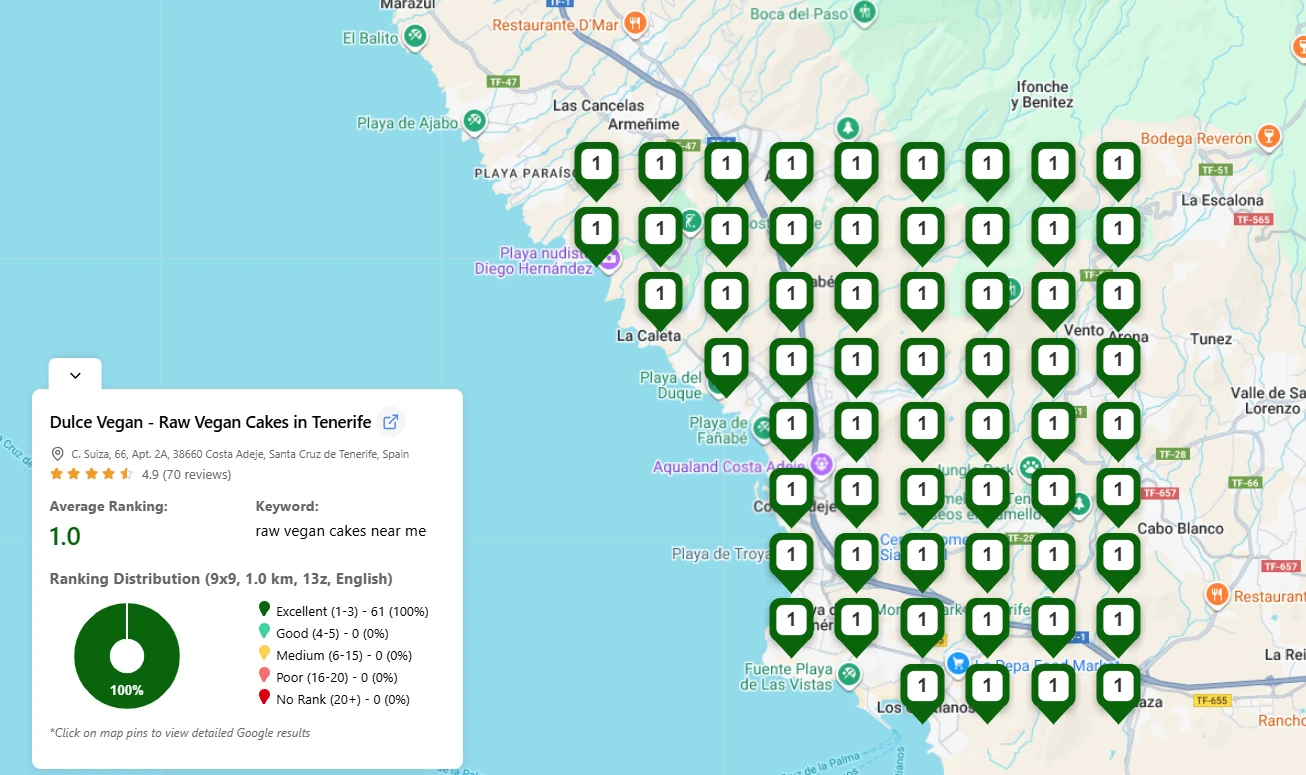
The most accurate local rank tracker is the one that runs each search from a fixed GPS point, at a zoom level and language you can see, with no search history attached. For Google Maps rankings, that means a geo-grid tracker. Of the five tools below, GTrack, Local Falcon and Local Dominator search from GPS pins on a grid; SE Ranking searches from a city or postal code; Moz Local manages listings and reports rankings on the side. We make GTrack, a Google Maps rank tracker, and it is our pick, so this guide also shows you how to check any tracker's numbers against Google yourself.
The 5 most accurate local rank trackers at a glance
| Tool | Where each search comes from | Grid | Free option | Starts at |
|---|---|---|---|---|
| GTrack | GPS coordinates of each pin; zoom level and result language on Advanced and higher | Up to 5x5 free, up to 1,000 points on paid plans | First scan with no account; Free plan with 200 credits a month | $0, paid from $19.99/mo |
| Local Falcon | GPS pin per grid point, Google Maps and Apple Maps | 3x3 to 21x21 | 100 credits when you sign up | $24.99/mo |
| Local Dominator | Points on a grid you set | Square or circle scans | Free trial of the Lite plan, no card | $39/mo |
| SE Ranking | A city or postal code | No grid | 14-day trial | Part of its SEO plans |
| Moz Local | Location-level reports inside a listings tool | Not its focus | No | Billed per location |
Prices are the monthly list prices on each vendor's site on October 14, 2026. They change, so check before you buy.
What makes a local rank tracker accurate
Google ranks local results on relevance, distance and prominence, and its help page on local ranking defines distance as how far each business is from the person searching. A local rank tracker has one job: pretend to be that person, standing in a known spot, and record what Google shows. Six settings decide whether it gets that right.
1. Where the search comes from
A tracker can set the searcher at a city center, inside a ZIP code or on exact GPS coordinates. Only coordinates match how a phone reports its position, and only a grid of them shows the street where you drop from position 2 to position 14. Our post on geo location rank tracking compares city, ZIP and GPS tracking side by side, with the blind spot of each.
Checking from your own doorstep flatters you. In our study of 286 audited Google Business Profiles, we ran one Google Places search for each of 233 businesses, for its own primary category and centered on its own map pin, and 54% came up in the top 3. Distance favors you most at that spot, so that one check says little about a customer five kilometers away.
2. Zoom level
Google Maps returns a different set of businesses at different zoom levels. GTrack's help article on zoom level and language explains that a low zoom such as 12z or 13z covers a larger area and pulls in businesses outside the neighborhood, while 15z to 20z narrows the results to a block or district. GTrack scans at 13z by default. If a tracker doesn't tell you its zoom, you can't compare its numbers with what you see on your phone.
3. Result language
If your profile has names or descriptions in more than one language, the result language changes how your listing appears. A Spanish-language search and an English one from the same pin can show your listing with a different name or description. Pick the language your customers use and keep it fixed.
4. Personalization
Your phone sends Google your history, your account and your saved places. A tracker sends none of that, which is why the two often disagree and why you should trust the tracker for trends. The post on tracking Google Maps rankings accurately covers the habits that ruin good data: changing the grid, scanning at random times and reading one scan as the truth.
5. Google Maps or the Local Pack
The three businesses in the map box on a Google search page and the list in the Google Maps app don't always match, so you can rank 2nd in one and 5th in the other. Check which one your tracker reports. Our guide to Google Maps vs the local pack explains the difference, and the Google local pack explainer shows what triggers the pack.
6. Where the pins land
A square grid on a coastline puts pins in the sea. A grid that runs past your service area adds pins where you never get a job. Both pull your average rank down for reasons that have nothing to do with your profile. Good trackers let you switch pins off or draw the grid as a shape.
How accurate are rank trackers? Check yours in five minutes
You don't have to take any vendor's word for it, ours included. Pick one pin from a scan and repeat the search by hand. The steps below follow GTrack's help article on verifying results with a spoofing extension, and they work for any tracker that shows you a pin's coordinates.
- Install a geolocation spoofing extension in Chrome, pin it to the toolbar and turn on "Allow in Incognito" in its settings.
- Open a finished scan and copy the GPS coordinates of one pin.
- Set those coordinates in the extension. The extension GTrack recommends picks up the copied coordinates on its own.
- Open the same keyword search in an Incognito window, so your cache, history and account don't change the results.
- Compare the businesses in the top 5 with what the tracker recorded for that pin.
Expect small differences. GTrack's help center says rankings vary from minute to minute, but the first 5 positions usually show the same businesses. Run the check at three pins: the center, an edge and a pin where you rank poorly. If the top 3 businesses differ at two of the three, the tracker is probably searching from another spot, at another zoom or in another language. Find out which before you trust its reports.
Tip: for a single city-level check with no tracker at all, the free Google search UULE generator builds a Google search URL with the location encoded in it.
The 5 most accurate local rank trackers, reviewed
We ranked these by how they set the searcher's location, then by how much control and verification you get. For pricing and features across ten tools, see our 10 best local rank tracker tools comparison.
1. GTrack
GTrack searches Google Maps from the GPS coordinates of every pin on a grid you set: a square such as 5x5 or 9x9, or a rectangle, circle or polygon you draw on the map. You choose the spacing in kilometers or miles and can switch off any pin outside your service area, which also saves credits. On the Advanced plan and higher you set the zoom level from 1 to 20 and the result language. Click a pin to see the Google results behind it, then copy its coordinates to check them yourself as described above.
- Free plan: $0 a month with 200 credits, grids up to 5x5, 1 tracked competitor and scheduled scans for up to 3 keywords. Your first scan is free with no account.
- Paid plans: Starter $19.99 (5,000 credits), Advanced $29.99 (15,000), Business $59.99 (36,000) and Pro $99.99 (81,000). One credit covers one point for one keyword, and paid plans go up to 1,000 points per scan.
- Scheduling: daily, every other day, weekly, every 2, 3 or 4 weeks, or monthly, with an email when each scan finishes.
- Competitors: from 1 on Free to 100 on Pro. GTrack also logs changes to their profiles (name, category, reviews, photos, posts) and emails you when a category changes or reviews move past a threshold you set.
- Keywords: AI Keyword Suggestions drafts 20 local keyword ideas to track.
Limits: GTrack's grid scans cover Google Maps only, with no Bing or Apple Maps; organic Google positions go through its separate Keyword Rank Tracker. Zoom and language settings aren't on the Starter plan. When we updated this post, the product page listed Local Pack scanning as temporarily offline.
A rank tracker reports positions on the map, not what AI assistants answer. GTrack's AI Tracker is a separate tool that checks whether AI assistants recommend your business in ChatGPT, Perplexity, Gemini and Google AI Mode.
2. Local Falcon
Local Falcon uses the same pin-based method: each credit is one map pin in a scan, so a 5x5 grid costs 25 credits. Its pricing page lists grids from 3x3 to 21x21 and scans on Google Maps and Apple Maps, which matters if many of your customers use iPhones. It also tracks AI visibility. Plans start at $24.99 a month for 7,500 credits, and a new account gets 100 free credits with no card.
Best for: agencies that want Apple Maps alongside Google Maps in one grid tool.
3. Local Dominator
Local Dominator runs grid scans where one credit equals one scan point, so a 10x10 square costs 100 credits. It also offers circle scans, which cover a round service area with fewer points than the square around it. Its G2 pricing listing shows Lite at $39 a month (5,000 credits), Advanced at $59 (15,000) and Enterprise at $399, and the credit guide explains how scans use them. Plans include SERP Tracker campaigns for organic results. There is no free plan, but you can start a Lite trial without a card.
Best for: agencies that scan many locations and want Maps and organic tracking from one subscription.
4. SE Ranking
SE Ranking's local rank tracker asks you for a city or a postal code, tracks desktop and mobile results separately, and checks whether you appear in the top 20 Maps results on a weekly or monthly schedule. That gives you one position per place. It works well for organic local rankings of a website, and it hides the drop-off between one side of a city and the other. Local tracking comes inside SE Ranking's general SEO plans, with a 14-day trial. Our guide to mobile rank tracking covers when the phone result matters and how to track it.
Best for: teams that already use SE Ranking for national SEO and want local positions in the same reports.
5. Moz Local
Moz Local is a listings tool first: it pushes your business data to directories, monitors reviews and reports on your local presence. Ranking reports are a smaller part of the product than in the tools above. You pay per location. The price tracker Costbench listed the Lite plan at $20 per location per month, or $199 a year with annual billing, when it last checked in August 2026.
Best for: multi-location brands whose bigger problem is inconsistent listings, not where they rank street by street.
Other rank trackers worth a look
These tools didn't make the top 5 for accuracy, but one of them may fit your budget or workflow better.
- Whitespark: its local rank tracker checks the Local Pack, Maps and organic results on Google and Bing from a city center, a ZIP code or exact coordinates, with keyword plans from $17 a month.
- BrightLocal: a local SEO suite with rank tracking, citation building and audit tools.
- Localo: simple grid tracking and competitor monitoring for small businesses.
- Local Ranking: Google Maps rank tracking with a plain interface.
- GMB Radar: Google Business Profile rank tracking.
- Grid My Business: grid-based rank tracking with heatmaps.
- GeoRanker: geographic rank tracking with international and multi-language support.
- ProRankTracker: a general rank tracker with local options and extensive reports.
- Rank Ranger: rank tracking inside Similarweb's SEO and marketing suite.
Do you need a local rank tracker?
You need one if customers find you on Google Maps and come from more than a few streets around your door. Search Console can't replace it: its position column averages every searcher, device and location into one number, so a business at 2nd near the shop and 19th across town can read as 8th. Our guide on how to check your Google Maps ranking walks through that gap with Search Console screenshots.
You don't need a local tracker if your rankings don't depend on where the searcher stands, as with an online store or a SaaS product. A general SEO rank tracker that checks positions by country does that job.
If you only need an occasional check, start free. GTrack's first scan needs no account, and our list of the best free rank trackers sets out the exact free limits of 11 tools.
How much does local rank tracking cost?
Grid trackers charge in credits, and GTrack, Local Falcon and Local Dominator all count one credit per point per scan. Your bill depends on three numbers: keywords, points and how often you scan. Two typical workloads for one location:
- Weekly: 5 keywords on a 7x7 grid (49 points), 4 scans a month = 5 x 49 x 4 = 980 credits.
- Daily: 3 keywords on a 9x9 grid (81 points), 30 scans a month = 3 x 81 x 30 = 7,290 credits.
| Plan | Price a month | Credits a month | Weekly (980) | Daily (7,290) |
|---|---|---|---|---|
| GTrack Starter | $19.99 | 5,000 | Fits | No |
| GTrack Advanced | $29.99 | 15,000 | Fits | Fits |
| Local Falcon Starter | $24.99 | 7,500 | Fits | Fits, 210 to spare |
| Local Dominator Lite | $39 | 5,000 | Fits | No |
| Local Dominator Advanced | $59 | 15,000 | Fits | Fits |
The Free GTrack plan's 200 credits cover a weekly 5x5 scan of one keyword (100 credits a month) with room for a second keyword every other week. Switching off pins you don't need cuts every one of these totals.
How often should you track local rankings?
Weekly suits most single-location businesses: you catch a drop within days and build a history you can compare. Scan daily for the two weeks after a big profile change, a category switch or a sudden loss of calls, then go back to weekly. Monthly is enough for a stable business in a quiet market. Whatever you pick, keep the same day, time, grid and keywords, or the trend line measures your settings instead of your rankings. Our post on how often to track Google Maps rankings covers when daily scans earn their credits and when to change your schedule.
Turning rank data into action
A scan tells you where you lose. To find out why, work through the map in this order.
- Read the pattern. Weak on every pin points to the profile. Weak on one side of town points to distance and service area. Our guide to reading Google Maps heatmap patterns decodes the common shapes.
- Check who beats you at the weak pins. Open the top 3 profiles at those points and compare categories, services, review count and recent posts with yours. If they also have more local links, our guide to local SEO backlinks shows how to earn them.
- Fix the profile. In our study, 56% of audited profiles had no services or described fewer than half of them. The free Google Business Profile audit runs the same 32 checks on your profile.
- Rescan on the same settings. Compare like with like, and give a change a few weeks before you judge it.
Frequently Asked Questions
Which rank tracker is most accurate?
For Google Maps, the most accurate trackers search from the GPS coordinates of each point on a grid and let you check those points by hand. GTrack, Local Falcon and Local Dominator all work that way. GTrack adds zoom and language control on its Advanced plan and documents how to verify any pin in an Incognito window with a spoofing extension.
How accurate are rank trackers?
A grid tracker that searches from exact coordinates should match a clean manual search from the same spot for the top 5 businesses most of the time. Positions move from minute to minute, so expect small differences lower down. City-level and ZIP-level trackers report the rank for one point in that area, which can be far from where your customers search.
Do I need a rank tracker?
Yes, if you get customers from Google Maps and serve more than a small area, because your position changes from street to street and Search Console only shows an average. If your rankings don't depend on the searcher's location, a general SEO rank tracker is enough.
How much does rank tracking cost?
Local grid trackers start at $0 (GTrack's Free plan, 200 credits a month) and run about $20 to $40 a month for a single location tracked weekly: GTrack Starter is $19.99, Local Falcon Starter $24.99 and Local Dominator Lite $39. Daily scans of 3 keywords on a 9x9 grid need about 7,300 credits a month, which fits Local Falcon Starter ($24.99) or GTrack Advanced ($29.99).
What is rank tracking?
Rank tracking is recording where a page or business appears in search results for chosen keywords, on a schedule, so you can see changes over time. Local rank tracking adds the searcher's location: the tool repeats each search from set points on the map, because Google ranks local results partly on distance.
Is there a free local rank tracker?
Yes. GTrack runs your first grid scan with no account, and its Free plan gives 200 credits a month for grids up to 5x5 with scheduled scans for 3 keywords. Local Falcon gives 100 credits when you sign up. Our best free rank trackers list compares the free limits of 11 tools.
GTrack: see your own grid before you pick a tool. Run a free Google Maps rank scan for your main keyword with no account, then check a pin or two against Google with the steps above.