A bad review on your Google Business Profile is one of two things. Either it breaks a Google policy, and you can report it and ask Google to take it down, or it is a real customer's honest bad experience, and Google will keep it. Most bad reviews are the second kind, and there is a lot you can do about those without removing anything.
Policy references are to Google's own help pages, checked on November 4, 2026.
What you'll learn
- How to tell a removable bad review from one Google will keep
- The two-minute version of reporting a review that breaks the rules
- A five-step playbook for a bad but genuine review
- How many five-star reviews it takes to lift your average, with a formula and worked examples (our calculation)
- What not to do, including one move that deletes your replies and keeps the review
How to remove bad reviews from Google My Business: which ones Google takes down
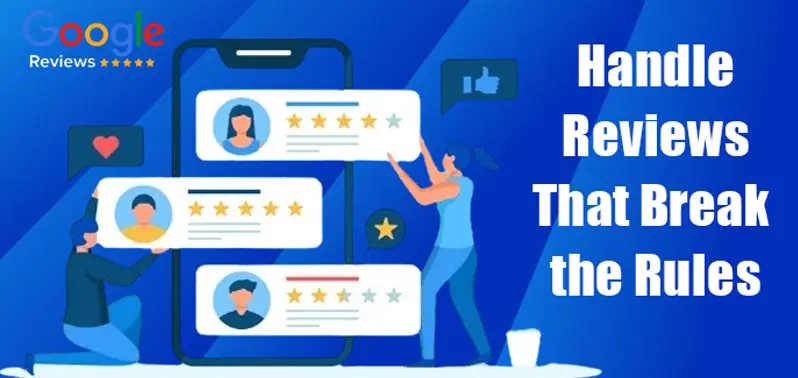
Google My Business is now called Google Business Profile, and the removal rules are the same under either name. Google removes a review only when it breaks its prohibited and restricted content policy. So the first step in how to remove bad reviews from Google My Business is to sort them:
| Bad review that Google can remove | Bad review that Google keeps |
|---|---|
| From someone who was never a customer (fake engagement) | From a real customer who was unhappy |
| From a competitor or a current or former employee (conflict of interest) | About price, waiting time, parking or opening hours |
| About something other than your business, or meant for another one (off-topic) | Describing a visit differently from how you remember it |
| With threats, slurs, profanity or someone's personal details | Saying a named staff member was rude or slow |
| The same text posted again and again (repetitive content) | A one-star rating with no text from a real customer |
Google's report page says reviews you disagree with or dislike are not eligible, and that it doesn't get involved in disagreements between businesses and customers (Report inappropriate reviews on your Business Profile). If your review is in the right-hand column, skip to the playbook below.
How to remove negative reviews from Google Business Profile when they break a rule
To remove negative reviews from Google Business Profile that break a policy, report each one. The same goes if you want to remove negative reviews from Google search results: the reviews Search shows are your Business Profile reviews, so there is no separate report for Search. The quickest route is from the profile:
- Go to your Business Profile on Google and select Read reviews.
- Next to the review, select the Report icon.
- Choose the reason that matches the review and select Send report.
Google says evaluation typically takes several days. You can check the status, and file your one appeal if Google keeps the review, in the Reviews Management Tool. Reporting from Google Maps, the status messages, what to write in an appeal, and what to do about fake review attacks and extortion are all in our step-by-step guide on how to get a Google review removed.
Remove a review from your business profile: only the reviewer can, if it is genuine
No. You cannot remove a review from your business profile because it is negative, and neither can anyone you hire. There is also no setting to hide reviews or turn them off; our answer to whether businesses can delete or hide Google reviews goes through every option owners ask about. One that people try and regret: removing the Business Profile itself. Google says that when you do, "User-generated content and review remains", while your posts, photos and review replies are permanently removed (Remove a Business Profile). You keep the bad review and lose your reply to it.
The only person who can take a genuine review down is the customer who wrote it.
What to do about a bad Google review that stays
What to do about a bad Google review from a real customer starts with your own records.
1. Check the facts before you write anything
Find the visit, order or job in your own records. Talk to the staff member involved. You are looking for two things: what really happened, and whether the complaint points at something you would want to fix anyway. A review that is half right still deserves a reply that admits the right half.
2. Reply in public, briefly and soon
The reviewer is notified when you reply, and Google says replies usually take up to 10 minutes to be checked before they appear, sometimes up to 30 days (Manage customer reviews). Google's own advice for negative reviews: keep it professional and short, apologize where it is fair, explain what you can and cannot do, and never share the reviewer's private information or attack them personally (Tips to get more reviews). The reply is written for the next customer who reads it as much as for the reviewer.
Hi [name], thank you for telling us. You waited 40 minutes past
your booking on Saturday, and that is on us: we double-booked the
chair. We have changed how weekend bookings are confirmed so it
does not happen again. If you would like to talk it through,
call [manager] on [phone].
Leave discounts and offers out of the public reply: Google's tips page advises against offering deals or promotions in responses. Templates for most situations are in how to respond to negative Google reviews.
3. Fix the cause, and say you did
If the complaint is fair, change the thing that caused it and mention the change in your reply, as in the example. The next customer reads both. If the same complaint shows up in several reviews, it is no longer one customer's bad day.
4. Ask the reviewer, once, whether they would update it
Google's reply guide says the reviewer can still edit their review after reading your reply, and its tips page says following up on a concern "may even encourage the customer to update their review." Asking is fine. Paying is not: Google's policy bans offering "payment, discounts, free goods and/or services" in exchange for "revision or removal of a negative review." Ask after the problem is fixed, ask once, and accept the answer.
Hi [name], we have [what you fixed]. If it changes how you feel
about your visit, you are welcome to update your Google review.
Either way, thank you for raising it.
5. Get new reviews from every customer
Every new review lowers the weight of the old one in your average. Send a review link or a QR code to customers after each visit or job (Google covers both in Tips to get more reviews), and send it to everyone. Google's policy bans merchants who "selectively solicit positive reviews from customers", and also bans asking staff to collect a set number of reviews. Our free Google review QR code generator makes printable cards, and how to ask for Google reviews has the wording.
How many 5-star reviews it takes to lift your average
Google says the review score "is the average of all ratings published on Google for that place or business", and that it may take up to 2 weeks for the score to update after a new review (Review scores). Because it is a plain average, you can work out exactly how many five-star reviews a target needs.
With n reviews at an average of r, the number of new five-star reviews k that brings the average to a target t is:
k = n × (t − r) ÷ (5 − t)      (round up)

Example: 20 reviews at 4.2, target 4.5
k = 20 × 0.3 ÷ 0.5 = 12 five-star reviews
| Reviews today | Average today | Target | New 5-star reviews needed |
|---|---|---|---|
| 20 | 4.2 | 4.5 | 12 |
| 50 | 4.2 | 4.5 | 30 |
| 100 | 4.2 | 4.5 | 60 |
| 50 | 3.8 | 4.2 | 25 |
| 200 | 4.3 | 4.5 | 80 |
The same formula answers the common question of how many five-star reviews cancel out one 1-star review. To hold an average of t after a single 1-star, you need (t − 1) ÷ (5 − t) five-star reviews: 3 to hold 4.0, 7 to hold 4.5, 13 to hold 4.7 and 19 to hold 4.8 (our calculation, rounded up).
Volume also decides how much one bad review hurts in the first place. A business with 10 reviews at 4.8 drops to about 4.45 after one 1-star; a business with 100 reviews at 4.8 drops to about 4.76 (our calculation). A steady flow of new reviews is the best protection against the next bad one.
What not to do with a bad review
- Do not offer anything for a change or removal. Google's policy bans it, as above.
- Do not threaten the reviewer. In the US, the FTC's 2024 rule on consumer reviews bans "unfounded or groundless legal threats, physical threats, intimidation, or certain false public accusations to prevent or remove a negative consumer review" (FTC, August 14, 2024).
- Do not post or buy positive reviews to bury it. Google can stop a profile that breaks its fake engagement rules from receiving new reviews, unpublish its existing ones and show a warning that fake reviews were removed (Business Profile restrictions). More in can you buy Google reviews.
- Do not report a genuine review as fake. Google will find no violation, and an appeal spent on it is spent on a review that was never going to come down.
- Do not remove your Business Profile. The reviews stay and your replies go.
See the next bad review the day it arrives
The playbook works best when the reply goes out while the visit is still fresh in everyone's memory. GLocal, our Google Business Profile tool, emails you when a new review lands, with up to three AI reply drafts you can post or edit, and, with Alert on Review Deletion switched on, emails you again when a review it has on record disappears. It does not remove reviews or detect fake ones. Its job is to make sure you see each review in time to act on it.
Reply to every review while it is new
GLocal sends an email for each new Google review with reply drafts in your chosen tone, and, if you switch on deletion alerts, a second email when a review is removed from your profile.
Frequently Asked Questions
Can I remove a bad review from my Google Business Profile myself?
No. Only the reviewer can delete it, and only Google can remove it, when it breaks a policy. You can report it, reply to it, and ask the reviewer once whether they would update it, without offering anything in return.
What should I do about a bad Google review?
If it breaks a Google policy, report it. If it is a real customer's experience, check the facts, reply briefly in public, fix the cause, ask the reviewer once whether they would update it, and ask every customer for a review so the average recovers.
Should I reply to a bad Google review?
Yes. The reviewer is notified when you reply, and the reply is public under the review for every future customer to read. Keep it short and professional, apologize where it is fair, explain what you changed, and never share the customer's private details.
How many 5-star reviews does it take to fix a 1-star review?
To hold an average of 4.5 after one 1-star review you need 7 new five-star reviews, to hold 4.8 you need 19, and to hold 4.0 you need 3 (our calculation, since Google's score is the average of all ratings).
How can I encourage more positive reviews for my business?
Ask every customer, not only the happy ones, with a review link or a QR code at checkout, on receipts or in a follow-up email. Google bans selective asking and incentives. Our free Google review QR code generator makes printable cards with your review link.