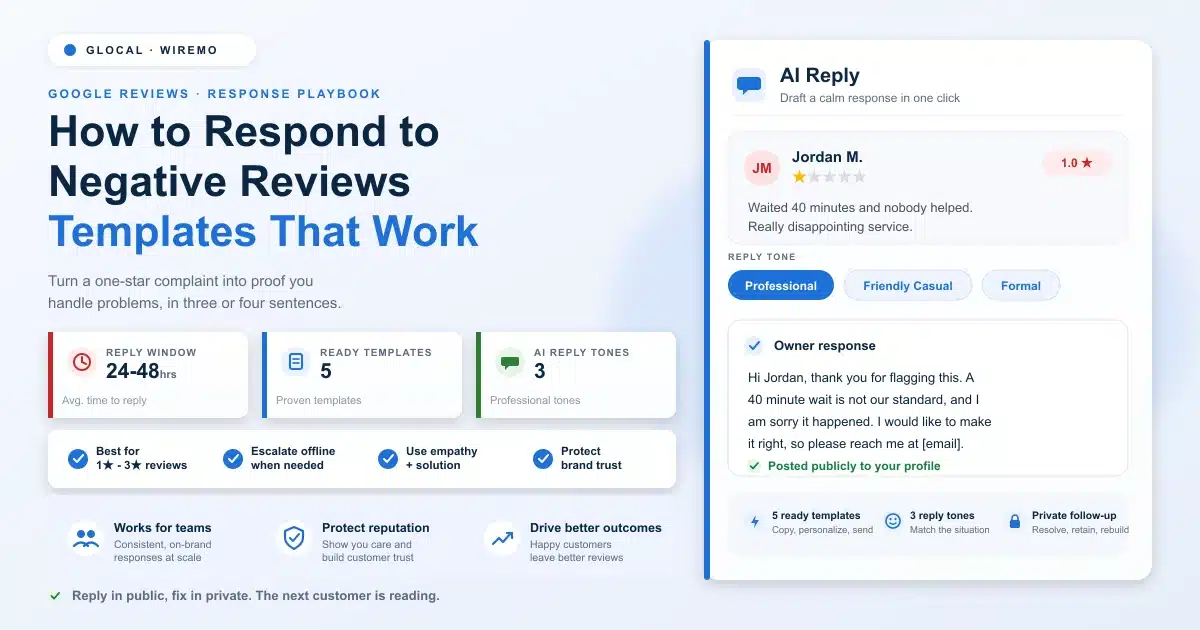
What you'll learn
- The four-part formula behind every reply that wins back a customer
- Five copy-and-edit templates for the negative reviews you actually get
- What a weak response and a strong one look like, side by side
- How to handle a fake or policy-breaking review without losing your cool
- Why a fast, public reply does more for the next customer than the upset one
Learning how to respond to negative Google reviews starts with a hard truth: a bad review feels personal. You read it, your stomach drops, and your first instinct is to defend yourself or pretend it is not there. Both instincts are wrong, and both cost you, customers.
Here is what most owners miss. The reply is not for the person who left the review. It is for the dozens of people who will read it next, weighing whether to call you or the business down the street. A calm, specific response tells everyone that you take problems seriously. Silence, or a defensive rant, tells them the opposite.
This guide gives you a formula that works for any complaint, five templates you can edit in two minutes, and clear examples of what to do and what to avoid. Knowing how to respond to negative Google reviews is a skill, not a talent, and you can have it by the end of this page.
Respond to Negative Google Reviews
When you respond to negative Google reviews, speed matters more than polish. A reply that lands within a day or two, while the review is still near the top of your profile, reaches the most people and shows the reviewer you were paying attention. A perfect reply written three weeks later talks to almost no one. Our guide to seeing your Google reviews shows where they are on a computer and in the Maps app.
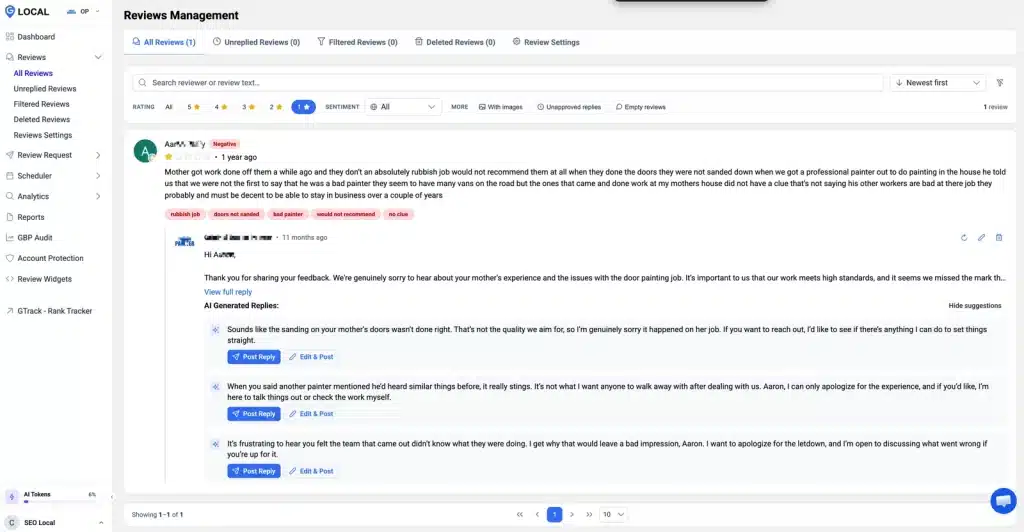
You do not need to watch your profile all day to move quickly. A review management console like GLocal pulls every Google review into one inbox, flags the unreplied ones, and tags each by sentiment, so a new one-star never sits unseen for a week. For each review, it drafts a few AI reply suggestions in your chosen tone, so you can post one straight away, open it with Edit and Post to fine-tune it first, or route it for approval before it goes live.
Every strong reply, no matter the complaint, does the same five things. Learn the pattern once, and you stop writing each response from scratch.
Negative Review Response Formula
The goal of a reply is not to win the argument. It is to look like the kind of business a reasonable person would still trust after something went wrong. That happens when you follow four steps in order, every time.
The four-part reply
- Thank and name. Open with their first name and a genuine thank you for the feedback.
- Acknowledge the specific issue. Name what went wrong in their words, with no excuses.
- Apologize and state the fix. Say sorry, then say what you are changing or offering.
- Move it offline. Give a real name, email, or phone so the next step happens in private.
Notice what is missing. No defending, no explaining why they are wrong, no company history. The reader does not want a courtroom. They want to see an owner who listens and acts. Keep the whole thing to three or four sentences, because a wall of text reads as a wall of excuses.
Critical: never share customer details in a public reply
Do not confirm someone was a client, reveal what they bought, or mention their account, health, or case in the open reply. It violates their privacy, it reads as petty, and in some industries, it breaks the law. Acknowledge the issue in general terms and take the specifics to a private channel.
Have a review to answer right now? Paste it into the free Google review reply generator, pick the star rating and a tone, and get 3 draft replies to edit and post. The same page has 50 reply templates, including 1-star, fake and no-text reviews.
How to Respond to Negative Google Reviews Templates
These five templates cover how to respond to negative Google reviews in the situations most local businesses actually receive. Swap the brackets for your details, match the tone to your brand, and keep them short. If staring at a blank reply box stalls you, GLocal can generate a first draft in a Professional, Friendly Casual, or Formal tone, and you edit from there instead of from nothing.
1. The legitimate complaint
Hi [Name], thank you for telling us about the [slow service/mix-up with your order]. You are right, that is not the standard we hold ourselves to, and I am sorry it happened on your visit. We have already [changed X / retrained the team] so it does not repeat. I would like to make it right directly, so please reach me at [email or phone].
2. The angry, emotional review
Hi [Name], I hear how frustrated you are, and I do not blame you. Thank you for taking the time to share this. I want to understand exactly what went wrong and fix it, so could you email me at [email]? I read every message myself and will get back to you the same day.
3. The factually wrong review
Hi [Name], thank you for the feedback. Our records show things may have played out a little differently, and I would genuinely like to get to the bottom of it with you. Please reach me at [email or phone] so we can compare notes and sort this out properly.
4. The one-star with no comment
Hi [Name], we noticed your one-star rating, and we would really like to understand what fell short. Your feedback helps us improve for everyone. If you have a moment, email me at [email] and tell me what happened so we can fix it.
5. The price complaint
Hi [Name], thank you for the honest feedback on pricing. We aim to price fairly for the [quality/time/materials] that go into the work, and I am sorry if that was not clear up front. I would be happy to walk you through what is included. Reach me at [email or phone] any time.
Bad Versus Good Reviews
A bad review is not the end of the story. The difference between a reply that helps and one that hurts is rarely the length. It is the posture. The same complaint can produce a response that wins the room or one that proves the reviewer's point. Here is how to respond to negative Google reviews so the reply wins the room, line by line.
| Weak response | Strong response |
|---|---|
| Opens by defending the business | Opens by thanking the customer and naming the issue |
| Argues the facts in public | Moves the details to a private channel |
| Copy-pasted, same line on every review | Specific to what this person actually said |
| Long, defensive, and emotional | Short, calm, and focused on the fix |
Good practice: reply to the happy ones too
A profile where the owner answers five-star and one-star reviews alike reads as engaged, not defensive. When every reply is a damage-control reply, the pattern itself signals trouble. Spread your responses across the good and the bad.
Respond to Fake Reviews
Not every negative review is from a real customer. You will get the occasional review from someone who confused you with another business, a competitor playing dirty, or a person you have no record of serving. These need a different move.
First, reply once, calmly and in public, noting you have no record of the interaction and inviting them to contact you so you can help. This protects you for the next reader, who can see you responded reasonably. Second, flag it. Google removes reviews that break its rules, and a review from someone who was never a customer often qualifies. Walk through the steps in Google's own guide to reporting reviews that violate policy, and check the content rules in Google's prohibited content policy so you flag on the right grounds.
Critical: never buy reviews to bury a bad one
Drowning a real complaint under fake five-star reviews is a fast way to get your whole profile suspended. Google detects review patterns, and the penalty costs you every review you earned honestly. Respond, fix, and earn new reviews the real way instead.
Negative Reviews Build Trust
Done consistently, learning to respond to negative Google reviews pays off well beyond the one upset customer. A single good reply rescues one relationship. A habit of good replies changes how your whole profile reads, and that shows up in the searches you win. Reviews and responses are part of the signal Google weighs when it decides which local business to show first.
So close the loop. After you fix the issue behind a cluster of complaints, watch whether your visibility actually recovers. A Google Maps ranking software like GTrack shows your real position across the map grid over time, so you can tell whether the work has moved you or not. And since the fastest way to outweigh a bad review is a steady flow of good ones, make leaving feedback effortless with a QR code review tool that customers can scan and rate in seconds.
The habit is easier than it sounds once you build a small routine around it. Set a standing time twice a week to clear new reviews, keep your five templates in a note you can paste from, and decide in advance who on the team owns the reply. When a one-star lands, you are not scrambling for words or arguing in the heat of the moment. You open the inbox, pick the template that fits, edit it to the specifics, and move on in two minutes.
The owners who win here are not the ones who never get a bad review. They are the ones who answer every review like the next customer is reading, because the next customer usually is.
Respond to Negative Google Reviews Questions
How fast should I respond to a negative review?
Within 24 to 48 hours. A quick reply reaches the most readers while the review still sits near the top of your profile, and it shows the reviewer you were paying attention. A response written weeks later is read by almost no one.
Should I respond to every negative review?
Yes. Knowing how to respond to negative Google reviews means answering every one, even the brief ratings. Every unanswered complaint is a story the reader finishes for themselves, usually badly. A short, calm reply to each one shows a pattern of an owner who listens, which does more for the next customer than any single response does for the upset one.
What should I never do in a reply?
Never argue the facts in public, never get defensive or sarcastic, and never reveal private customer details. Do not copy and paste the same line onto every review, either. Acknowledge the specific issue, apologize, and move the details to a private channel.
Can I get a negative Google review removed?
Only if it breaks Google's content rules, such as spam, a fake review from a non-customer, or prohibited content. You can flag those for review. A review that is simply unflattering but honest will not be removed, so the better path is a strong public reply.
How do I respond to a one-star review with no comment?
Reply anyway. Thank them for the rating, say you would like to understand what fell short, and invite them to email you directly. It signals to readers that you care even when you were given nothing to work with.
Does replying to reviews actually help my ranking?
Indirectly, yes. Learning to respond to negative Google reviews builds the engagement signals Google reads, and a profile that shows steady, thoughtful replies looks like an active, trustworthy business. The bigger win is conversion: readers choose the business that clearly handles problems.
Should I offer a refund or a discount in the public reply?
Keep specific offers private. In the public reply, acknowledge the issue and invite them to contact you. Then handle the refund, discount, or fix one-on-one. Posting offers publicly can invite bad-faith reviews from people fishing for the same deal.
Knowing how to respond to negative Google reviews comes down to a calm formula, a few ready templates, and the discipline to answer quickly and in public. Thank, acknowledge, apologize, and take it offline. Do that every time, and the review that felt like a disaster becomes the post that quietly wins your next customer.