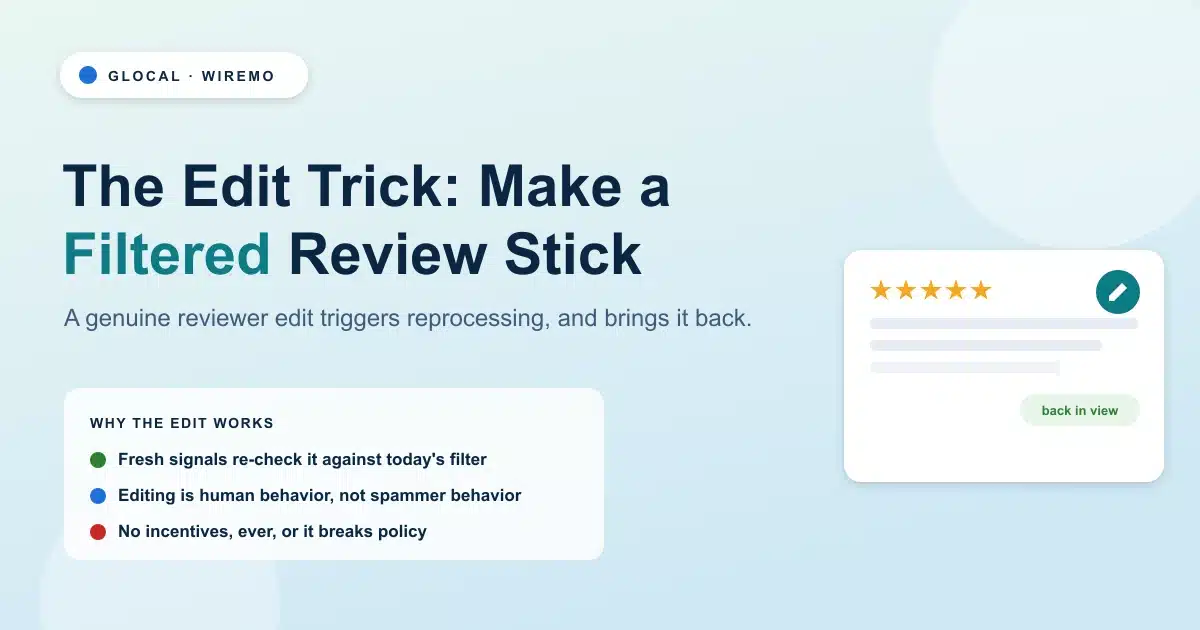
TL;DR – What you'll learn:
- What it actually means when Google shows your review as filtered, not deleted
- Why a genuine reviewer edit can push filtered Google reviews back into public view
- The five-step way to ask for an edit without breaking any Google rule
- A copy-paste message you can send a customer today
- When the edit trick works, and the cases where nothing will save the review
Filtered Google reviews feel like a glitch you cannot reach. The review is real, the customer is real, and yet Google quietly tucked it out of public view. Here is the part most owners never hear: you often have one clean, policy-safe lever to bring it back, and it runs through the reviewer, not through an appeal form. Ask the right person to edit their own review, and you hand Google a reason to look at it again.
This is a practical guide, not a theory piece. You will see why the edit works, the exact steps to ask for one, and a message you can paste into an email in the next five minutes. You will also see the honest limits, because this is a nudge that works for a real reason, not a magic button.
Filtered Google Reviews Explained
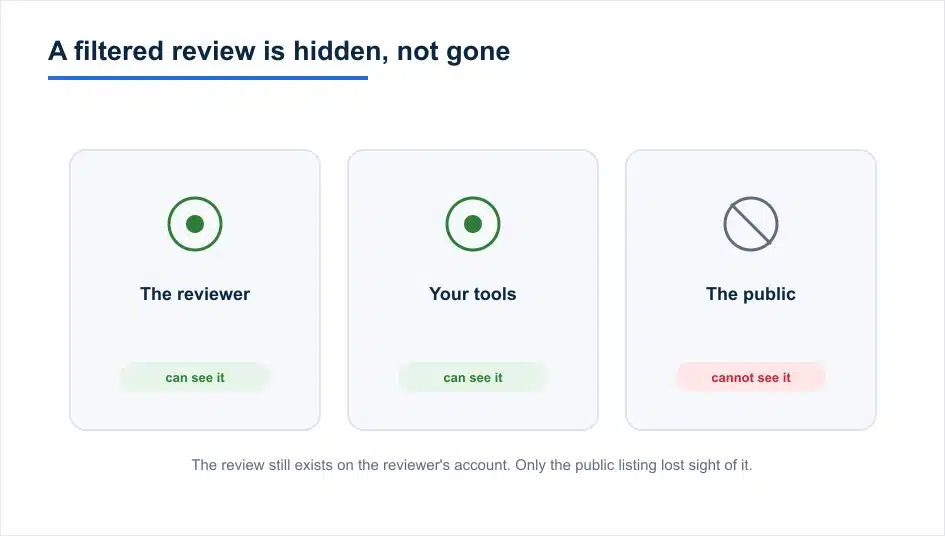
Start with what filtered actually means, because it is not the same as gone. A filtered Google review failed Google's spam check and got pulled from the public listing, but it has not been erased. The reviewer can usually still see it on their own profile when they are logged in. Your tools can still see it sitting in a filtered or removed bucket. Only the public has lost sight of it. If your review simply stopped appearing and you are not yet sure filtering is the cause, our guide on why a Google review not showing up helps you pin down the reason first, then come back here to act on it.
That distinction is the whole reason the edit trick is even possible. You are not trying to resurrect something that was destroyed. You are trying to get a review that already exists re-checked under fairer conditions. A filtered review tracker helps here by flagging exactly which reviews dropped into the filtered bucket and when, so you know which ones are candidates instead of guessing at a shrinking number.
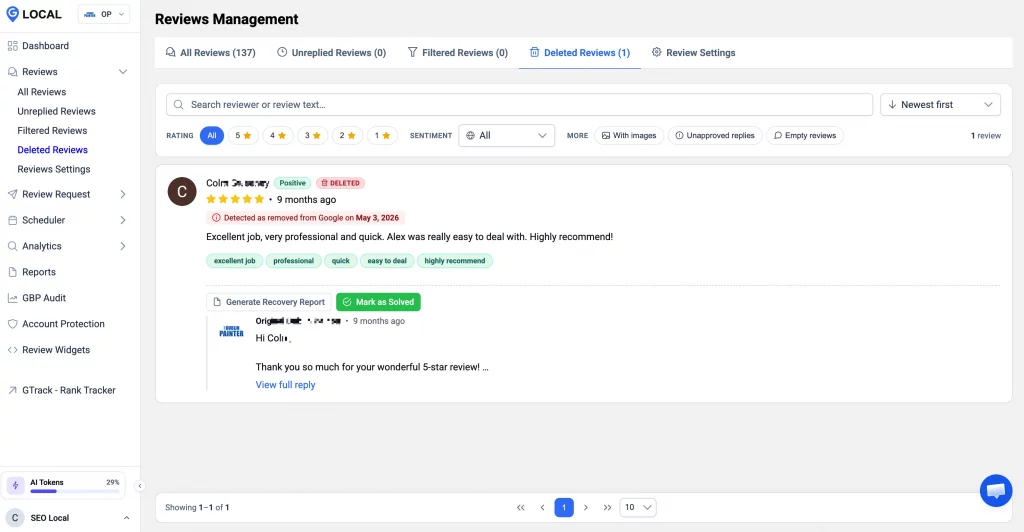
Here is the practical way to surface those candidates instead of eyeballing a shrinking number. GLocal pulls every Google review into one inbox, then flags anything Google takes out of public view in a Deleted Reviews tab, with each one stamped with the date it dropped. An alert fires the moment a review is filtered, so you catch it early, while the customer still remembers the visit and is most willing to help. From that same view you can generate a recovery report and mark each one solved once it returns. If a review turns out to be gone rather than filtered, the steps to recover deleted Google reviews pick up where the edit trick stops. A few clicks turn a vague sense that reviews are slipping into a dated shortlist of exactly which filtered Google reviews to act on.
To find them, open Reviews Management in GLocal, go to the Deleted Reviews tab (its label for any review Google takes down, filtered ones included), and sort by date. Every review Google pulled from your public listing sits there with its removal date, which tells you at a glance which filtered Google reviews are recent enough to be worth an edit request.
Filtered does not mean you did anything wrong. Genuine reviews get caught all the time, usually because something about the pattern looked risky to an automated system: a new reviewer account, a burst of reviews on the same day, wording that pattern-matched to spam. The review itself can be completely honest and still land in the filtered pile.
Editing Filtered Reviews Works
Here is the mechanism, plainly. When a reviewer edits their review, Google does not just save the new text. It treats the edit as a fresh submission and runs the review back through the spam filter as it exists today. Two things shift in your favor at once.
First, the rules may have moved. The filter that flagged the review weeks ago is not frozen. It gets tuned constantly, and a review that looked borderline under one version can pass cleanly under the next. An edit forces that re-check instead of waiting on a slow, automatic one.
Second, and this is the part people miss, editing is not what spammers do. A fake-review operation fires its reviews and walks away. It never circles back a month later to add a sentence about the friendly staff. A real customer does. So an edit sends a strong human signal: a genuine account, recent and deliberate activity, real engagement with a specific business. Those are exactly the signals the filter uses to decide a review is trustworthy.
FRESH SIGNALS
The edit re-submits the review for scoring against the current filter, with new, recent activity attached to a real account.
HUMAN BEHAVIOR
Going back to refine a review is something genuine customers do and spam networks never bother with. That reads as trust.
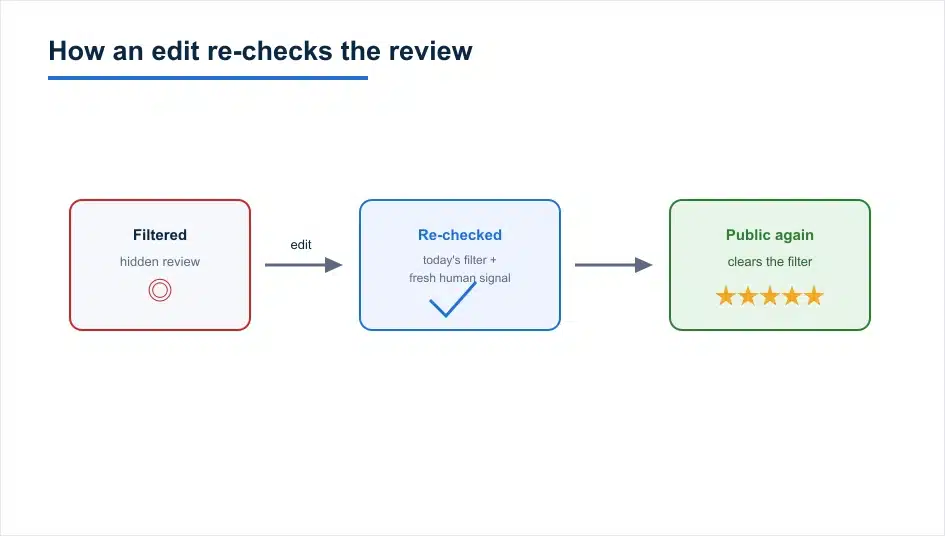
So the edit is not a loophole. It produces the precise conditions the filter rewards: a real person, genuine recent engagement, and a fresh evaluation under today's rules. That is why it can work where an angry appeal does nothing.
The Filtered Review Fix
Recovering filtered Google reviews is simple, and the order matters. Rushing to message a customer before you have confirmed the review is filtered, not deleted, wastes the one ask you get. Walk it in five steps.
Confirm it is filtered, not deleted
If the reviewer can still see it on their profile, or it shows in your filtered log, it is a candidate. If the customer deleted it or closed their account, stop here. No edit can reach it.
Identify the reviewer
You almost always know who they are from your records: the name on the review, a recent booking, an email thread. You need a real way to reach a real customer, not a stranger.
Reach out honestly
Send one warm, low-pressure message. Tell them their review seems to have dropped off Google, which happens to genuine reviews, and ask if they would be willing to update it.
Let them edit in their own words
They open the review on Google Maps and follow Google's own steps to edit their review, adding or changing a genuine detail about their experience. They write it, not you. A single honest sentence is plenty.
Wait and watch
The edit re-submits the review for scoring. If it clears, it returns to public view, usually within a few days. If it stays hidden, it was a policy or trust issue, and you move on without pushing again.
Filtered Review Edit Script
The message does most of the work, and the wrong message can sink the whole thing. Keep it short, warm, and honest. Acknowledge the review, explain plainly that it slipped off Google, and invite an update without telling them what to say. Here is a version you can paste and adjust.
COPY-PASTE REQUEST
Hi [first name], thank you again for taking the time to review [business name]. We noticed your review recently dropped off our Google page, which sometimes happens to genuine reviews for no fault of the reviewer. If you have a spare minute, opening your review and updating it with a sentence about your visit often helps it show again. Only if you are happy to, and no pressure at all. Either way, we really appreciated your kind words.
Notice what the message does not do. It does not hand them a script to copy. It does not promise a discount or a freebie for editing. It does not ask them to raise their rating. It simply tells the truth and leaves the writing to them. That honesty is not just polite, it is what keeps the whole move on the right side of Google's rules.
DO THIS
Make the ask effortless. Include a direct link to your Google listing in the message so the customer reaches their review in one tap. The easier the path, the more edits actually happen, and a GBP health scan is a good first check that your listing is clean and easy to find before you start sending people to it.
When Editing Reviews Works
Be clear-eyed about this. The edit trick is not a universal undo. It works in a specific situation: the review is genuine, it came from a real account, and it was filtered because the pattern looked risky rather than because the content broke a rule. That covers a large share of unfairly filtered Google reviews, which is why the method is worth knowing.
Filtered Google reviews recover best when the review was recent enough that the customer still remembers the visit and is willing to help. It works better still when your wider review habits look natural, because the filter scores the neighborhood around a review, not just the review alone. Steady, genuine reviews coming in over time make any single edit more likely to pass.
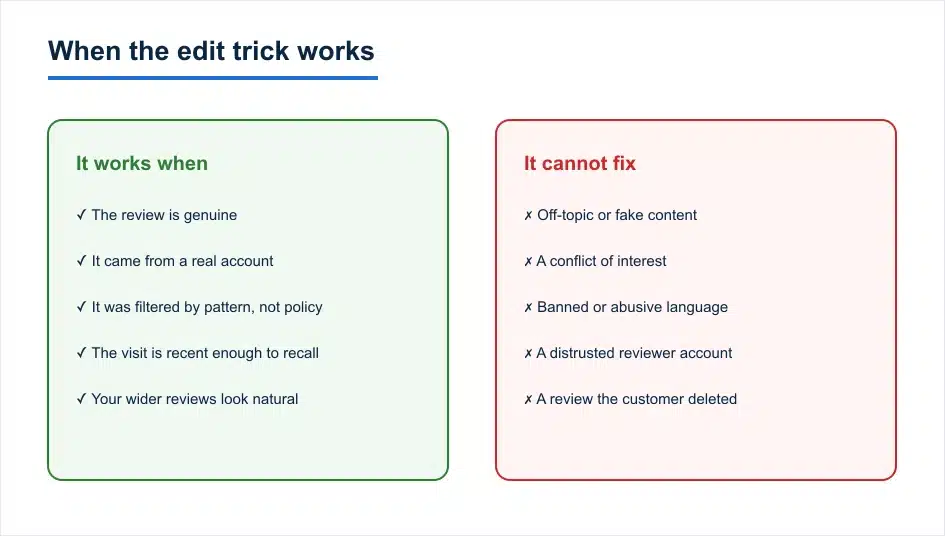
What it cannot fix is a review that deserved to be filtered. If the content was off-topic, came with a conflict of interest, included banned language, or came from an account Google distrusts, an edit will not rescue it. Pushing harder in those cases is wasted effort, and the honest move is to focus on earning fresh reviews instead. After a review returns, it is worth checking whether your visibility moved with it, and a Google Maps position checker like GTrack shows whether the recovered review actually lifted your standing on the map or just your count.
Filtered Review Recovery Limits
The fastest way to ruin a good tactic is to turn it into a manipulative one. The edit trick stays safe only as long as the edit is genuinely the reviewer's choice and the reviewer's words. Cross that line and you are no longer recovering a review, you are gaming one, and Google is very good at spotting the difference.
DO
- Ask only real customers who left a genuine review
- Let the customer write the edit themselves
- Send one polite request, then leave it
- Keep earning genuine reviews consistently over time
DON'T
- Offer a discount, gift, or anything in return for an edit
- Write the review text and ask them to paste it
- Mass-message everyone whose review dropped
- Ask them to change their star rating
DON'T DO THIS
Never offer money, discounts, or freebies in exchange for an edit or a review. That is review gating, it violates Google's policy, and it can get the review removed or your whole profile penalized. The edit trick works precisely because it is honest. Bolt an incentive onto it and you turn a safe recovery into a real risk.
The edit trick is one of the few moves that respects both the reviewer and the rules. It does not beg Google, it does not fake anything, and it does not cost a customer more than a minute. Confirm the review is filtered rather than deleted, reach the real person behind it, ask once and ask honestly, and let their edit do the talking. Most filtered Google reviews that were caught unfairly will quietly come back, and the ones that do not were never yours to recover in the first place.
Filtered Google Reviews Questions
What does it mean when a Google review is filtered?
A filtered Google review failed Google's automated spam check and was hidden from the public listing, but it has not been deleted. The reviewer can usually see it on their own profile, and it appears in business tools in a filtered or removed bucket. Filtered is not the same as deleted, which is why these filtered reviews can often be recovered.
Does editing a filtered Google review really bring it back?
Filtered Google reviews often come back when the review was genuine and filtered by mistake. Editing re-submits the review to the spam filter as it exists now, adds fresh activity from a real account, and signals human behavior that spammers never show. Those conditions can push a marginal filtered review back into public view.
How do I ask a customer to edit their review without breaking Google rules?
Send one honest, low-pressure message that explains their review dropped off and invites them to update it in their own words. Do not write the text for them, do not offer anything in return, and do not ask them to raise their rating. The request must be a genuine choice, not an incentive.
How long does a filtered review take to come back after an edit?
When an edit clears the filter, the review usually returns to public view within a few days. If it stays hidden for a week or more, the review most likely had a policy or trust problem that an edit cannot fix, and it is better to stop pushing and focus on new reviews.
Can every filtered review be recovered with an edit?
No. The edit trick only helps filtered Google reviews that were genuine and caught unfairly. A review that broke a content rule, carried a conflict of interest, or came from a distrusted account will stay filtered no matter how it is edited. In those cases, earning fresh honest reviews is the only real path forward.
Is the edit trick against Google's terms?
Asking a real customer to update a genuine review is not against the rules. What crosses the line is paying or rewarding someone for an edit, writing the review for them, or pressuring a rating change. Keep the edit honest and reviewer-driven and you stay firmly within Google's policy.