What you'll learn
- The Q1/Q2 algorithm cycle that makes reviews vanish on a schedule
- A quarter-by-quarter calendar of when removal risk peaks and eases
- Why a review that passed in January can fail the same test in April
- The difference between a hidden review and a truly deleted one
- How to time your collection so a spring dip barely shows
You check your profile one morning, and the number is wrong. Forty-one reviews last week, thirty-six today. Nobody asked for them to be taken down, no customer changed their mind, yet five are simply gone. It feels random. It is anything but. Reviews tend to vanish on a calendar, and once you can read that calendar, the morning panic turns into a planning problem.
This guide is not about appeals or filing a case. It is about the pattern underneath the losses: a trust system that runs all year, tightens hard in spring, and loosens again by winter. Understand why Google reviews disappear in that rhythm, and you can decide when to push for reviews, when to expect dips, and when to simply hold steady.
Why Google Reviews Disappear
Start with the part nobody tells you: Google never promises a review is permanent. Every review you receive is scored for trust the moment it lands, and that score is not set once. The system keeps re-running in the background, weeks or months after a review was posted, comparing it against whatever the current rules consider normal.
So a review can sit happily on your profile through winter, look entirely fine, and then get re-scored and pulled out of sight in spring without a single thing about it changing. The reviewer did not edit it. You did nothing wrong. The standard it was measured against simply moved.
That is the mechanical heart of why Google reviews disappear. It is not a verdict on your service. It is a probability model deciding, on this pass, that a review looks slightly less trustworthy than it did last time. A deleted review tracker like GLocal logs each disappearance with its date, so a drop becomes a recorded event you can reason about instead of a vague sense that something is off. How that alert reaches you is on the Google review monitoring page.
Seasonal Review Removal Pattern
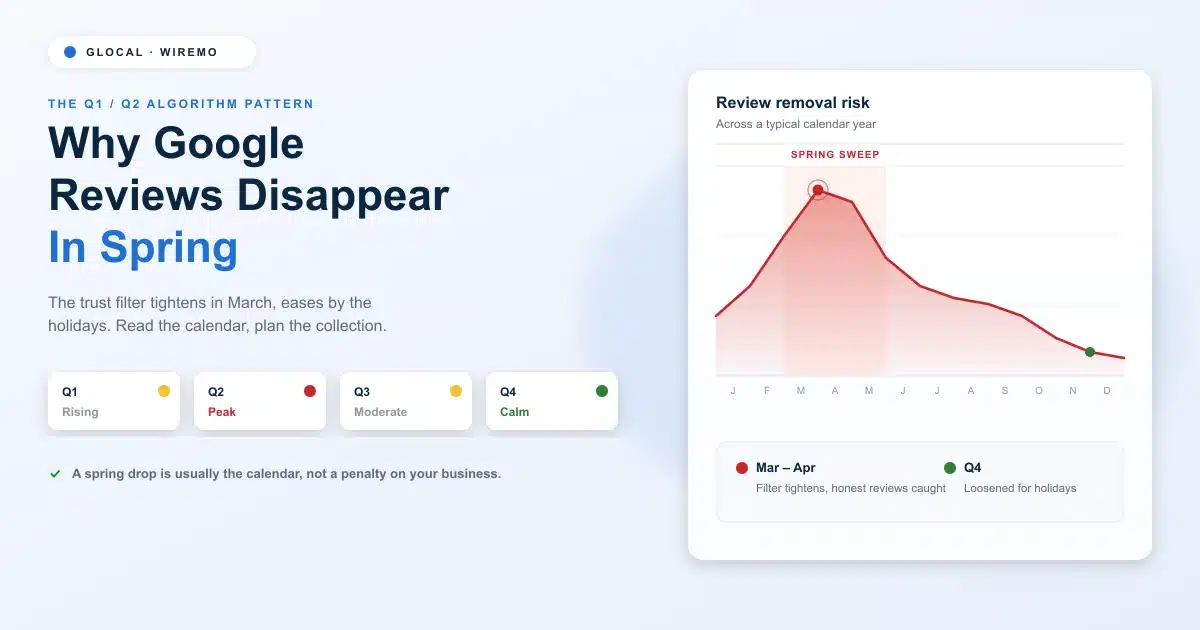
The losses are not spread evenly across the year, and that is the most useful clue you have. Local businesses tend to notice the biggest culling in late winter and spring. The quieter stretch, the run into the holidays, tends to see far fewer surprise drops.
The timing is not luck. People who have worked on these trust and safety systems describe a yearly rhythm: spam detection gets tightened hard in the March and April window, then deliberately loosened heading into the fourth quarter, when holiday traffic peaks and engineering teams sit under a code freeze that keeps risky changes out of production. The stricter spring build is the one that re-scores your back catalogue, and the reviews sitting closest to the trust line drop off first.
That single fact reframes a March drop. It is rarely a penalty aimed at you. It is collateral from a model running at its most cautious setting, on the schedule it runs that setting every year. Knowing the season is coming is most of the battle, because it lets you prepare instead of react.
Review Removal Calendar
Treat the year as a planning calendar rather than a mystery. Each window carries a predictable level of removal risk, which tells you when to push for reviews and when to brace for a dip. The goal is simple: bank reviews while the filter is relaxed, and stop feeding it fresh material to scrutinize when it is at its strictest.
| Window | What the filter is doing | Removal risk | Your move |
|---|---|---|---|
| Jan – Feb | Tuning begins after the holiday rush settles | Rising | Start your backup, ease off bursts |
| Mar – Apr | Heaviest tightening, old reviews re-scored hardest | Peak | Expect dips, slow asks, log every drop |
| May – Aug | Settles into steady, moderate enforcement | Moderate | Collect steadily, fix any flagged listings |
| Sep – Dec | Loosened for holiday traffic and the code freeze | Calm | Push collection hard while the window is quiet |
The practical read is to front-load. A review backup tool lets you build a buffer in the calm quarters and automatically log anything that drops in the high-risk ones, so the spring sweep meets a business that is prepared rather than surprised.
Review Spam Filter Cycle
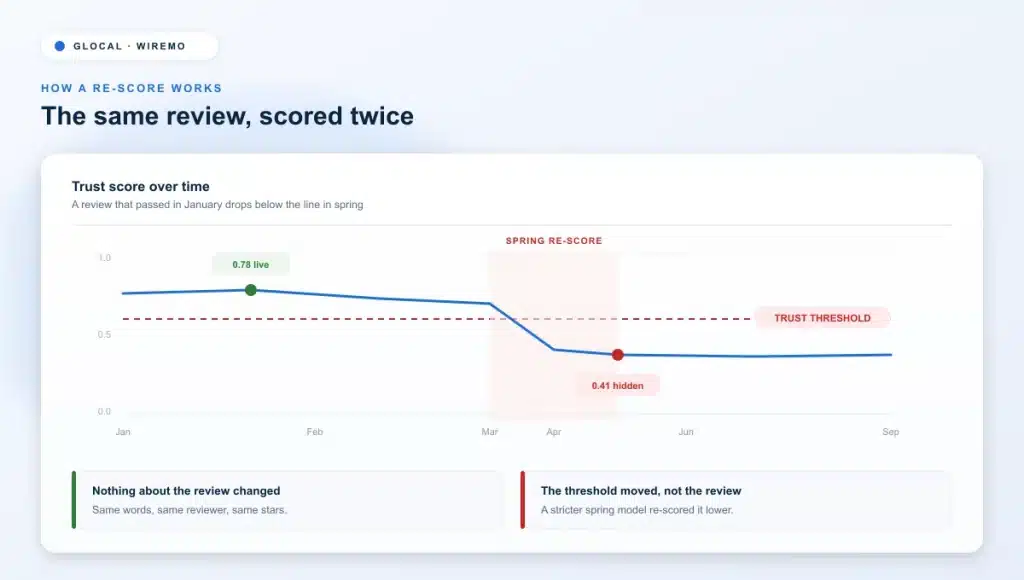
To see why a quiet review suddenly fails, picture a single line: the review's trust score, with a threshold drawn across it. As long as the score sits above the line, the review shows. Drop below it, and the review is pushed out of sight. The score itself is a blend of signals about the reviewer, the timing, and the wording, and none of those need to change for the outcome to change.
What changes is the line. When the spring build raises the bar, every review near the threshold is suddenly underwater, even though the reviews themselves are identical to the ones that passed in January. That is the cycle in one image: not new evidence against a review, just a stricter standard applied to the same evidence.
This is why honest reviews get caught alongside the fake ones. A burst from a single location, a reviewer with a thin profile, copy that reads like a template, each nudges the score down a notch. Stack a few of those small penalties, and a genuine review can slip under a raised line. The system is scoring probability, not truth, which is exactly why how you collect matters as much as what your customers say.
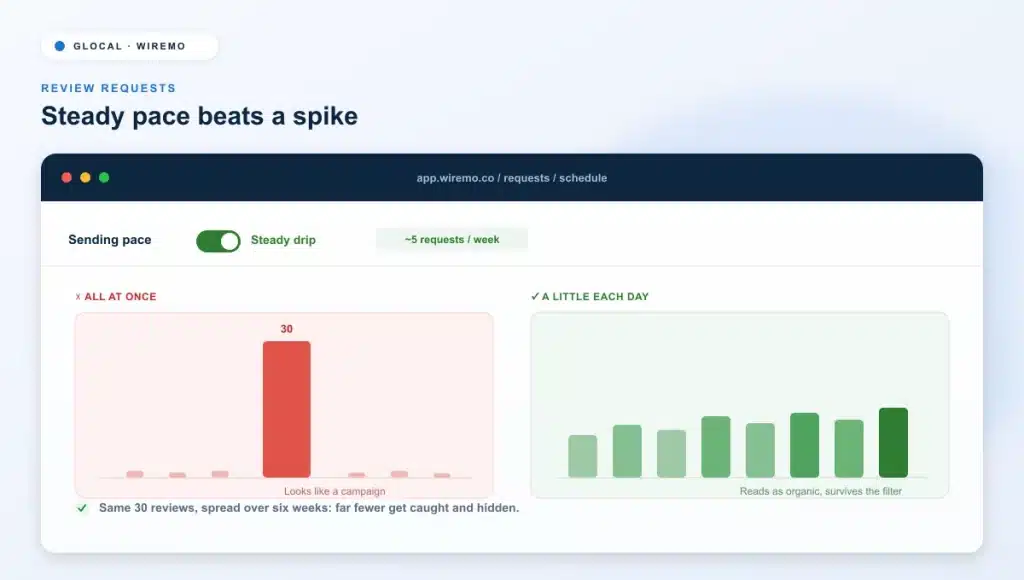
Critical: do not run a review party
Gathering a stack of reviews at one event, on one network, in one afternoon is the exact clustered pattern the spring filter hunts. You will often watch those reviews vanish within days, and the burst can pull down the trust of the reviews around it. Replace losses with a slow, steady trickle instead.
Disappearing Versus Deleted Reviews
Here is the distinction that changes how you act. Most reviews that vanish in spring are not deleted at all. They are hidden. The filter scored them below the line and stopped showing them, but the review still exists, because it belongs to the account that wrote it, not to your business. Your profile was only ever displaying it.
A hidden review can come back. When the year softens toward Q4 and the stricter model relaxes, some spring-hidden reviews get re-scored above the line again and simply reappear, with no action from anyone. A truly deleted review is a different animal: it is gone only when the reviewer removes it themselves or their Google account is closed, which takes its reviews with it.
| When | What the model is doing | Spring-hidden reviews are showing again |
|---|---|---|
| Q2 (the sweep) | Strictest build hides borderline reviews | Mostly hidden |
| Q3 | Enforcement settles, the bar eases down | Some return |
| Q4 | Loosened for the holidays, the threshold relaxes | Many resurface |
This is an illustrative shape, not a promise, but the direction is the point. A review that passed no rules and only fell foul of a stricter season is not a loss to mourn. It is a dip that often corrects itself once the calendar turns.
Plan Around Review Removal
You cannot stop the seasonal cycle, but you can build a business that barely feels it. The whole game is timing and records. Push collection hardest in the calm quarters, so you carry a healthy buffer into spring, and keep a copy of every review as it arrives so a removal is a documented fact rather than a fuzzy memory.
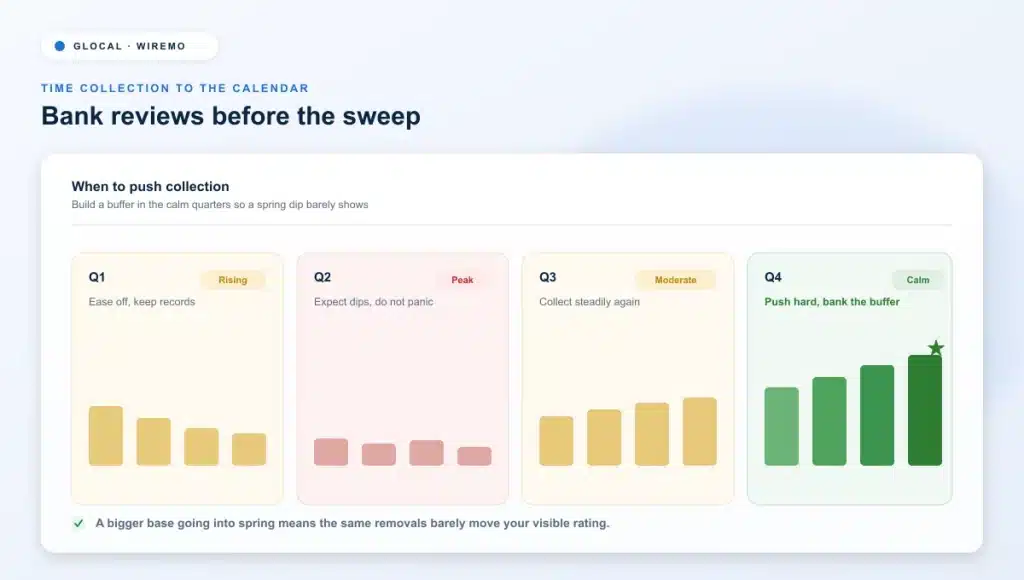
A larger, steadily built base is its own defense. When a handful of reviews drop in April, a profile sitting on a deep, well-paced history hardly moves, while a thin profile built on one big push can swing a whole star. After the sweep passes and your count recovers, watch whether your visibility follows with a map ranking monitor like GTrack, so you can tell a cosmetic dip from one that actually costs you position on the map.
If you want to understand exactly what crosses the line, Google sets out the rules in its prohibited and restricted content policy, worth reading once, so your collection habits stay on the safe side of the filter.
Good practice: size your buffer
Losing a few reviews stings less when your base is deep enough to absorb it. If you are not sure how many reviews you need to hold your rating through a spring dip, a rating impact calculator shows the math in seconds.
Disappearing Google Reviews Questions
Why did my Google reviews suddenly disappear?
Most sudden drops come from the spam filter re-scoring old reviews, usually during the seasonal tightening in late winter and spring. A review posted months ago can be hidden later without any action from you or the customer. If you have wondered which single thing explains why Google reviews disappear overnight, this quiet re-scoring is it.
Is there really a seasonal pattern to review removal?
Yes. Removals cluster in the first half of the year, with the heaviest sweep in the March and April window, then ease toward the fourth quarter when systems are kept stable for the holidays. Treating the year as a calendar of risk lets you collect in the calm months and brace in the strict ones.
Are disappeared Google reviews gone forever?
Not always. A review hidden by the filter still exists, because it belongs to the reviewer's account, and it can resurface when the model relaxes later in the year. It is only permanent when the reviewer deletes it or their Google account is removed.
Why do real reviews get caught by the spam filter?
The filter judges patterns, not honesty. Reviews that arrive in a tight cluster, come from thin accounts, or read like planted copy all lower the trust score, even when they are genuine. When the spring build raises the threshold, those borderline honest reviews are the first to slip under it.
Does losing reviews hurt my ranking?
A shrinking count and a falling rating can soften your visibility over time, since reviews feed into how Google weighs local results. A single seasonal dip rarely moves much, especially on a deep base. A steady decline is the real risk, which is why a calm, year-round collection habit matters more than any one review.
When is the safest time to ask for reviews?
The calmer second half of the year, especially the run into the holidays, is the lowest-risk window to push collection. Building your buffer then means a spring sweep lands on a bigger, sturdier base and barely shows.
How do I keep proof of a review that vanished?
Keep a rolling backup that stores each review as it arrives, not just when something goes wrong. A copy made after a review disappears is too late, while one running in the background means you always have the text, date, and author on hand.
Why Google reviews disappear comes down to a filter that never stops scoring, a season when it scores hardest, and a few collection habits that make honest reviews look risky. Read the calendar, bank your reviews in the calm quarters, expect the spring dip, and treat a hidden review as a maybe rather than a loss. None of it requires gaming the system. It just requires understanding the rhythm and building a steady habit around it, so the morning the number drops becomes a line on your to-do list instead of a crisis.