Over 40% of search queries are now handled by AI systems. Not keyword-matched. Not link-ranked. Answered by AI.
If your local business isn't showing up in those AI-generated answers, you're not losing to better competitors. You're losing to businesses that figured out the new rules faster.
This guide breaks down exactly how to use AI to dominate local SEO in 2026, from keyword research to content creation, Google Business Profile optimization, and review management.
I'll show you what's actually working.
Note: If you're tired of chasing reviews manually and watching competitors outrank you on Google Maps, Wiremo puts your entire reputation on autopilot. It collects reviews, responds with AI, and embeds structured data that tells search engines exactly why they should recommend you. If you want a system that works for your local SEO while you focus on running your business, claim your free trial here.
Use AI to Dominate Local SEO: The Strategies That Actually Work
Most businesses think "using AI for local SEO" means asking ChatGPT to write a blog post. Swap the city name, hit publish, done.
That's not a strategy. That's a shortcut to getting filtered out.
AI search engines don't rank pages. They rank answers, looking for businesses with consistent mentions, deep local relevance, structured data they can read, and a reputation that signals trust.
The businesses winning local search today run these as one connected system. Most businesses treat them as separate tasks. Keywords over here. Content over there. Reviews somewhere else. That's why nothing compounds.
Here's the system:
- Find the hyper-local queries your customers actually use
- Build pages that AI search engines recognize as locally authoritative
- Optimize your Google Business Profile to signal freshness and relevance
- Automate your reputation so reviews and responses work for your SEO 24/7
Each step feeds the next. Here's how to build it.
#1: Use AI for Hyper-Local Keyword Research
77% of consumers use local search at least once a week to find nearby services. That's not occasional browsing. That's an active, recurring buying behavior happening in your market right now, and most of it is happening on queries your current keyword list doesn't cover.
Traditional keyword tools show you search volume. They tell you 1,200 people search "plumber Austin" every month. What they don't tell you is that nobody actually types "plumber Austin" when their basement is flooding at 9 pm on a Sunday.
They type: "emergency plumber near South Congress open right now."
A standard keyword tool gives you:
- plumber Austin — 1,200/month
- Austin plumbing services — 880/month
- emergency plumber Austin — 320/month
An AI tool prompted to think like a local customer gives you:
- "who fixes burst pipes near Mueller on weekends"
- "emergency plumber South Congress open Sunday night"
- "how much does emergency plumbing cost in East Austin"
- "plumber near me that takes same-day appointments"
- "drain cleaning near Cherrywood under $200"
The first list gets you impressions. The second list gets cited by LLMs and hired by new customers. That's because the second list is built around search intent, not search volume. Start there, and the right tool follows.
Using AI to Reverse-Engineer Competitor Strategies and Keyword Gaps
AI tools can analyze competitor strategies effectively, uncovering the keywords your rivals target, how their content is structured, and where their gaps are.
Take your top local competitor's best-ranking service page and feed it into an AI tool. Ask it to identify what keywords and topics the page targets, what local intent signals it uses, what neighborhood-specific content is missing, and what you could write to outrank it by being more locally specific. Then ask for content ideas targeting the queries that the page is completely ignoring.
Your competitors have already done the hard work of figuring out what ranks. AI just helps you find the holes they left open.
How to Map Local Search Intent Instead of Chasing Exact Phrases
AI-powered keyword research is less about matching phrases and more about understanding what the searcher actually wants. Someone searching "emergency plumber Saturday night" doesn't want an article about plumbing. They want a phone number and a reason to trust you fast.
Use AI to categorize your keyword targets by intent, informational, navigational, transactional, and build your content to match each type precisely. Transactional keywords should land on service pages with a clear CTA above the fold. Informational keywords belong on top of funnel blog posts or FAQ content.
#2: Use AI to Build Local Pages That Actually Rank
Knowing which keywords to target is half the job. This is the other half: turning those keywords into pages AI search engines actually surface.
AI systems treat generic service area pages as interchangeable. When every business in your category has one "Areas We Serve" page, none of them get recommended. Neighborhood-specific pages break that tie.
Building Neighborhood-Level Supporting Pages Using AI and Geographic Data
Creating unique supporting pages for every neighborhood you serve, not just a single "service area" page, is one of the highest-leverage moves in local SEO right now.
Each neighborhood supporting page should reference local landmarks, address area-specific problems, mention familiar streets and districts, and include service content that proves you operate there. AI tools can help you scale this across dozens of neighborhoods faster than any human writing team.
When building each page, use AI to generate the structure and draft, then edit the output with what AI can't add on its own. Real job examples from that area. Actual response times. Local landmarks your customers recognize. These specifics are what separate a page that ranks from one that gets filtered out.
What Local Data Actually Looks Like on the Service Page
The businesses winning neighborhood search aren't just mentioning the area. They're adding data specific to that location that no competitor can replicate with a generic AI prompt.
Downtobid is a great example of this done right.
Their drywall contractors in Dallas directory page doesn't just list contractors and call it a day. It leads with proprietary local data specific to that market, bidding difficulty, average response time, average interest distance, and average lead time to bid, all pulled from real bid packages in that exact location.
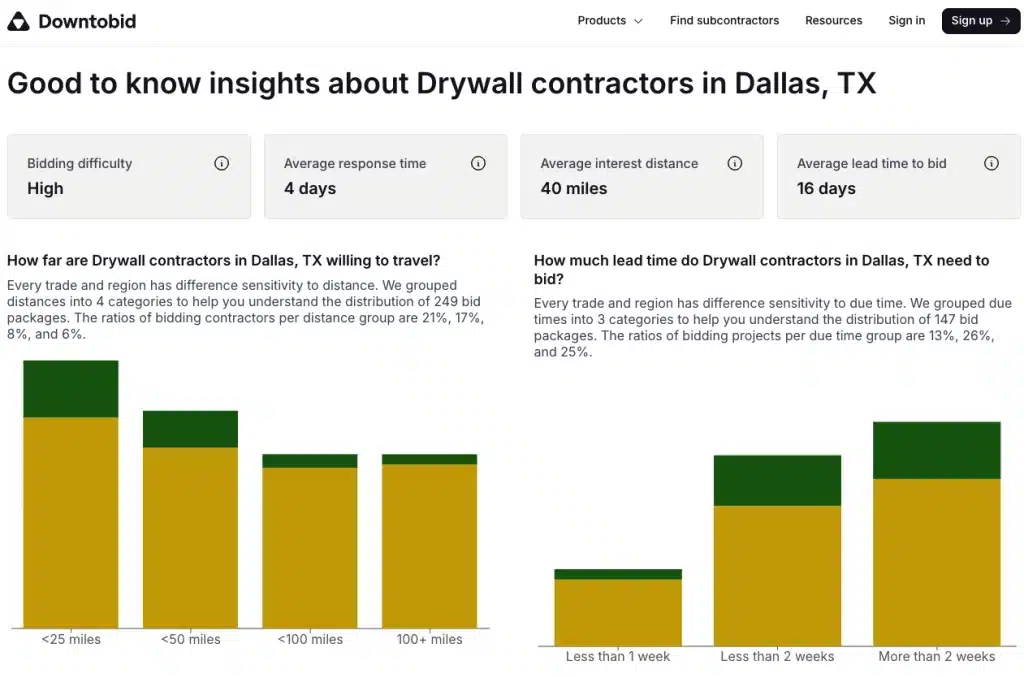
A contractor searching for that information gets an answer no other page in that category can give them.
The principle applies directly to local service businesses. Your version of that data layer already exists. You just haven't put it on the page yet.
For a neighborhood service page, that looks like:
- Average response time for jobs in that specific area
- Common problems you see in that neighborhood and why they happen there
- Real jobs you've completed on local streets, customers recognize
- Pricing ranges specific to the types of properties in that area
- Seasonal issues that affect that neighborhood more than others
That's the standard worth aiming for. AI can generate your structure and your draft. But the data layer, the real local insights no competitor has access to, is what turns a neighborhood page from a ranking attempt into a genuine local resource.
Using AI to Turn Customer FAQs Into Long-Form Local Content
The questions your customers ask daily are exactly what they're typing into AI search engines. "How long does it take?" "Do you service [neighborhood]?" "What's included?" These aren't just customer service questions. They're a content roadmap hiding in plain sight.
A one-line FAQ answer tells AI search engines there's nothing worth surfacing. A thorough, locally-contextualized answer tells them you're the authority on that topic in that area.
Here's how to turn your FAQs into local content that ranks:
- Write down every question a customer has asked you in the last 90 days. Include the ones that feel obvious; those are often the highest-intent searches.
- Group them by service and by neighborhood. "How long does drain cleaning take in East Austin?" is a different content opportunity than "How long does drain cleaning take?" The local version is less competitive and more likely to surface in a nearby customer's search.
- Feed each question into an AI tool with this instruction: "Write a thorough, locally-specific answer to this customer question for a [business type] serving [neighborhood/city]. Include: a direct answer in the first sentence, why this is specific to customers in [area], what the process looks like, and what the customer should expect. Write it the way a knowledgeable local expert would answer, not a generic FAQ template."
- Edit the output with real specifics, your actual timelines, your real pricing ranges, and examples from jobs you've done in that area. That layer of ground-truth detail is what AI can't generate and what search engines reward.
The businesses AI search engines pull as the authoritative local answer have deep FAQ pages. The ones with one-liners are invisible.
How to Optimize Local Content for Voice Search and Natural Language Queries
Voice searches convert at a higher rate than typed queries because they signal immediate intent. Someone talking to their phone at 10 pm needs a solution right now, not next week. And voice queries look nothing like typed keywords.
A typed search: "emergency plumber Austin"
A voice search: "Hey Siri, who's the best emergency plumber near me open right now on a Sunday?"
Here's how to write content that captures voice search traffic:
- Go through your existing service pages and identify every heading that reads like a keyword rather than a question. "Emergency Plumbing Services" becomes "Who provides emergency plumbing in [neighborhood] on weekends?" That reframe alone changes what your page surfaces for.
- Add a conversational Q&A block to every service page. Each question should mirror exactly how a local customer would ask it out loud, including time-based queries like "open now," "same day," and "available tonight."
- Lead every answer with the direct response in the first sentence. Voice assistants and AI search engines pull the first clear answer they find. Don't make them dig for it.
- Use AI to generate the voice-specific version of your keyword list by running this prompt: "Take these keywords and rewrite each one as a voice search question a local customer in [city/neighborhood] would ask Siri, Alexa, or Google Assistant out loud. Include urgency-based and time-based variations."
Write for the conversation, not the search bar.
#3: Use AI to Optimize Your Google Business Profile
Your Google Business Profile is your most powerful local SEO asset, the digital storefront that provides essential information across Google Search and Maps, and the first thing AI systems look at when deciding which local business to surface.
Most businesses set it up once and forget it. That's a costly mistake.
AI-Generated Business Descriptions That Include Local Keywords
Your business description isn't just for humans. AI systems use it to understand what you do, where you do it, and who you serve, so write for two audiences simultaneously: the customer reading it and the AI chatbots deciding whether to recommend you.
Use AI tools to write and refine business descriptions that naturally include location-based keywords, two to three specific neighborhoods or areas served, a concrete result or proof point, and a natural call to action.
Then edit the output with what AI can't add, the hyper-local detail. The street you're on, a nearby landmark, the specific problem your neighborhood deals with. That specificity is exactly what AI search engines look for when deciding which description to surface.
What a Generic Description Gets Wrong
The generic output, what you get when you prompt AI without local context:
"ABC Plumbing is a professional plumbing company serving the Austin area. We offer a wide range of plumbing services, including repairs, installations, and emergency callouts. Our experienced team is committed to quality workmanship and customer satisfaction. Contact us today for a free quote."
That description could belong to any plumbing business in any city in any country. There's nothing for AI to latch onto, no neighborhood, no specific service, no proof point, no reason to recommend this business over the 47 others saying the same thing.
What a Locally-Optimized Description Looks Like
Here's what you get when you give AI the right context:
"East Austin's go-to emergency plumber for Cherrywood, Mueller, and Holly neighborhoods. We're on-site within the hour for burst pipes, blocked drains, and water heater failures, with upfront pricing and no weekend surcharges. Locally owned and operated near the 183 for over a decade."
Same business. Same service. Completely different signal to both the customer reading it and the AI deciding whether to recommend it.
The difference isn't the writing. It's the prompt.
The Prompt That Produces the Second Version
"Act as a local SEO expert. Write a Google Business Profile description for a [business type] in [city]. Include: the two or three specific neighborhoods you serve, your most common emergency or urgent service, one concrete proof point like response time or years in business, and your pricing or availability policy. Keep it under 750 characters. Do not use generic phrases like 'committed to quality' or 'customer satisfaction.' Write it the way a local business owner who knows the neighborhood would, not a marketing agency that doesn't."
Using AI to Write Google Posts, Q&As, and Review Responses at Scale
AI tools can generate Google Posts for promotions, seasonal updates, and service highlights in minutes. They can populate your Q&A section with answers to the common questions that nearby customers are actually asking. And they can help you maintain a review response cadence that signals engagement and trustworthiness to both Google and LLM search platforms.
Run a monthly content batch using AI, posts, Q&A pairs, and review response templates in one sitting. Edit each output with specific local details, a recent job, a local event, a neighborhood reference, before publishing.
Or skip the prompting entirely. Wiremo's free Google Business Profile Post Generator generates ready-to-publish posts in seconds, just enter your business type, location, and what you want to promote. No ChatGPT tab required.
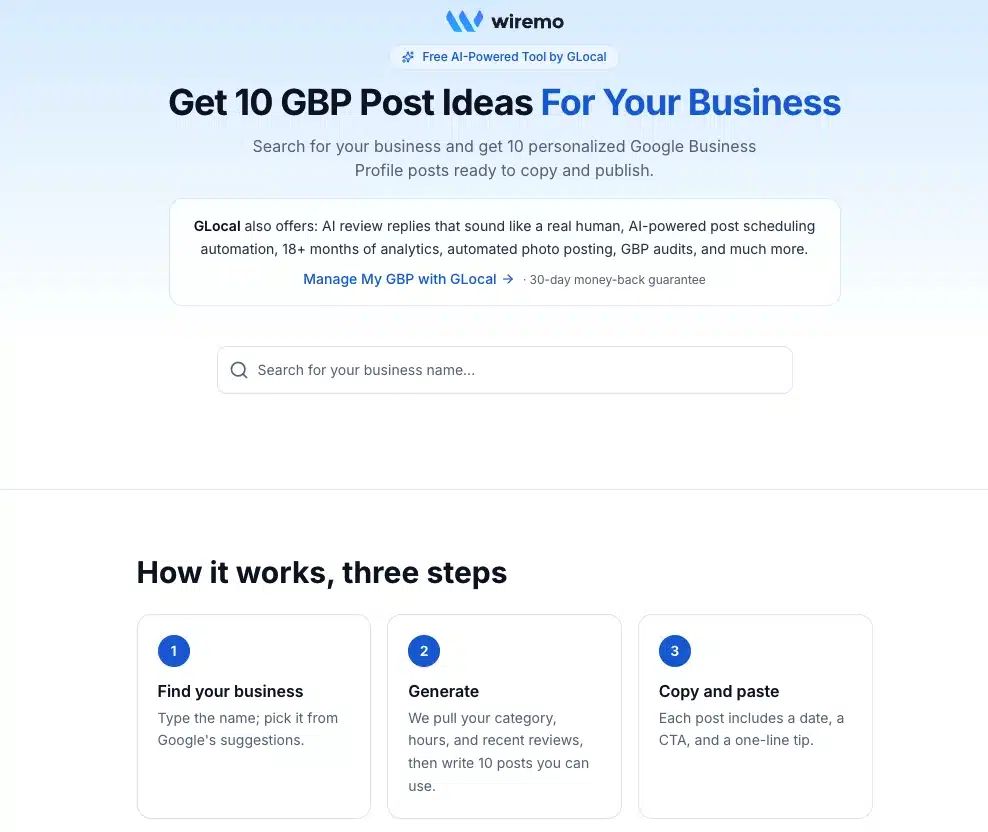
Consistency beats perfection. A profile active every week outperforms a polished one untouched for three months.
#4: Use Wiremo to Put Your Local Reputation on Autopilot
You've got the keywords. You've built the pages. Your GBP is active.
Now here's the layer that compounds everything else: your reputation.
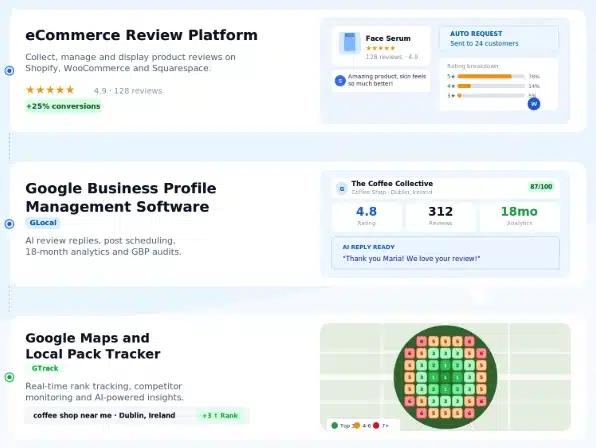
Before a potential customer clicks anything, AI systems have already scanned your review volume, response rate, sentiment patterns, and recency. All of that happens in seconds. All of it influences whether your business gets surfaced or skipped.
Most local businesses lose this battle not because they have bad reviews, but because they're inconsistent. Requests go out late or not at all. Responses pile up unanswered. Negative feedback sits unaddressed for days.
Wiremo closes that gap by automating the entire review lifecycle, collection, response, structured data, and GBP optimization, so your reputation works for your local SEO whether you're thinking about it or not.
Learn more about Wiremo's Google Business Profile management software.
For local businesses trying to show up in LLM search, it's not a nice-to-have. It's the infrastructure.
Using Wiremo's AI Categorization to Uncover Hidden SEO Opportunities
Wiremo's AI automatically tags every review by theme, service speed, staff friendliness, pricing, location convenience, and specific services mentioned. That categorization becomes your keyword and content strategy.
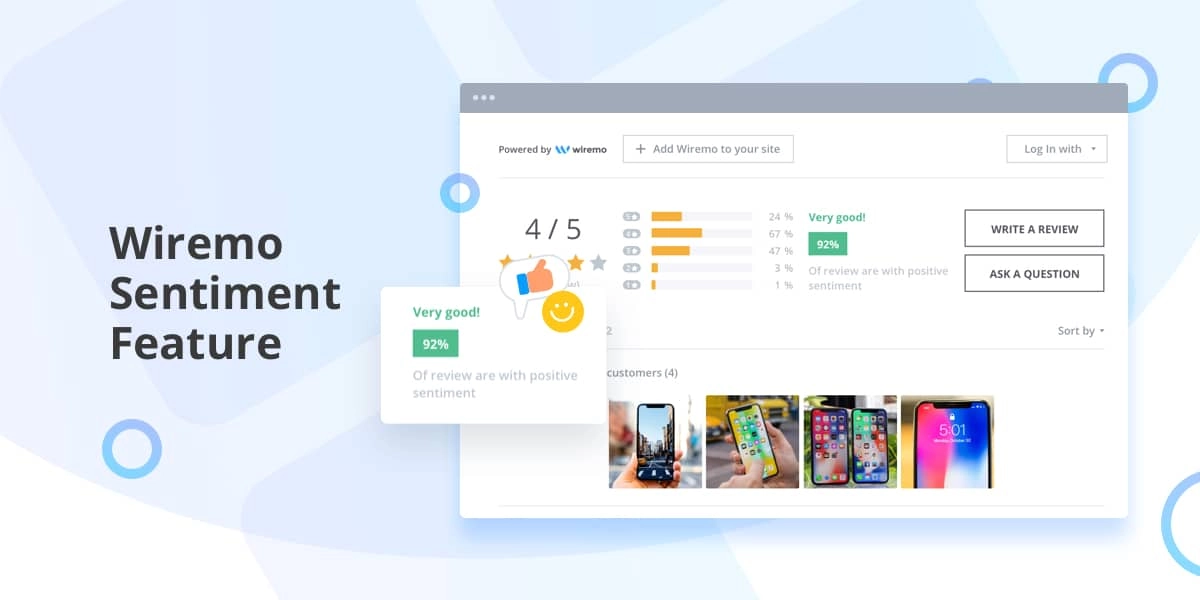
If "quick turnaround" dominates your positive reviews but you're not ranking for "fast [service] near me," that's a gap.
If "friendly staff" appears in 60% of reviews but your website says nothing about your team, that's a content opportunity. The AI spots these patterns at a scale you can't match manually.
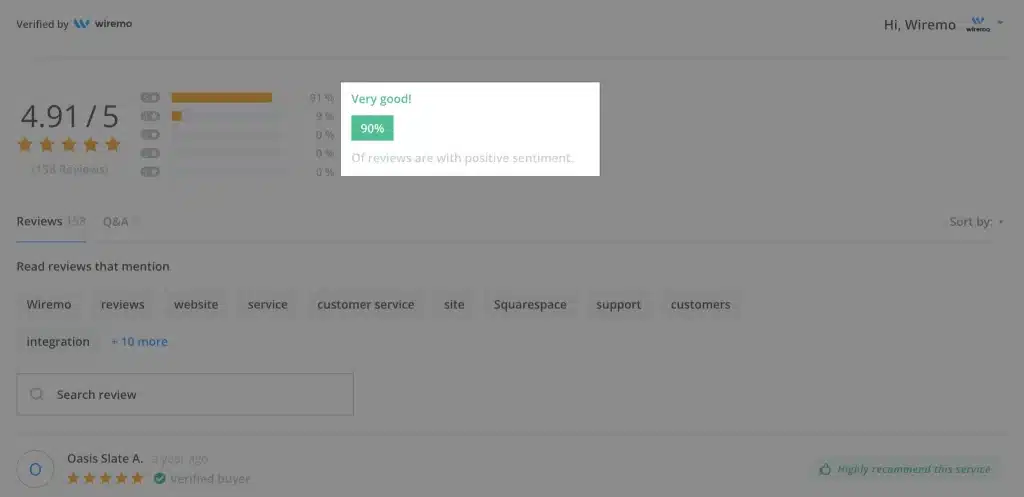
Here's how to turn those patterns into an action list:
- Export your Wiremo review tags and note the top three to five themes appearing most frequently.
- Open Google Search Console and check whether you're ranking for keyword variations of those themes.
- For every theme with no matching page or ranking, add it to your content plan as a dedicated service page, FAQ entry, or neighborhood supporting page.
- Use AI to generate long-tail keyword variations for each theme, specifically how a local customer in your area would search for a business known for that quality.
- Build one piece of content per gap, starting with the theme that appears most in your reviews.
The reviews are already telling you what to write. Wiremo just makes it impossible to miss.
Setting Up Automated Review Triggers for Consistent 5-Star Ratings
Reviews play a crucial role in local SEO, and AI analyzes customer feedback to generate insights that directly enhance visibility. And if you're wondering exactly how reviews impact SEO, Wiremo breaks that down in detail.
Wiremo's AI triggers send automated, personalized review requests the moment a transaction is completed. No manual follow-up. No missed opportunities. The customization is what sets it apart; instead of a generic message, Wiremo tailors the request based on the customer's specific interaction, driving a higher rate of 5-star ratings, which directly improves your Map Pack ranking.
Need help getting this configured? Wiremo's step-by-step trigger setup guide walks you through the entire process.
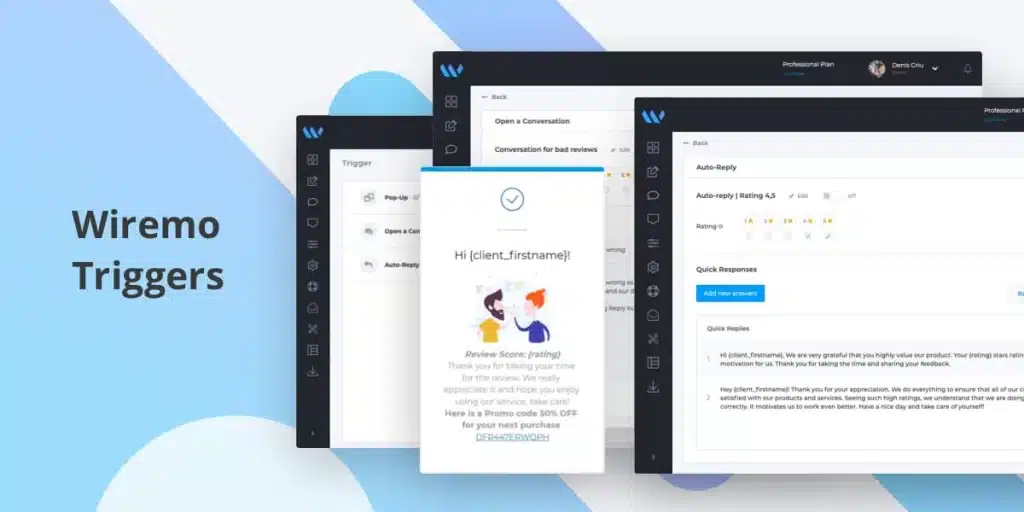
The businesses collecting reviews consistently aren't asking more. They're asking at the right moment, automatically, every time.
Smart AI Replies That Weave In Local Keywords Naturally
Google rewards businesses that engage with every reviewer, positive and negative. Wiremo's auto-reply feature handles this natively. For positive reviews, Wiremo's AI responses naturally weave in neighborhood names, service types, and local landmarks, turning every reply into a local relevance signal.
For negative reviews, the system flags the issue immediately and opens a support ticket, killing the bad PR before it affects your ranking.
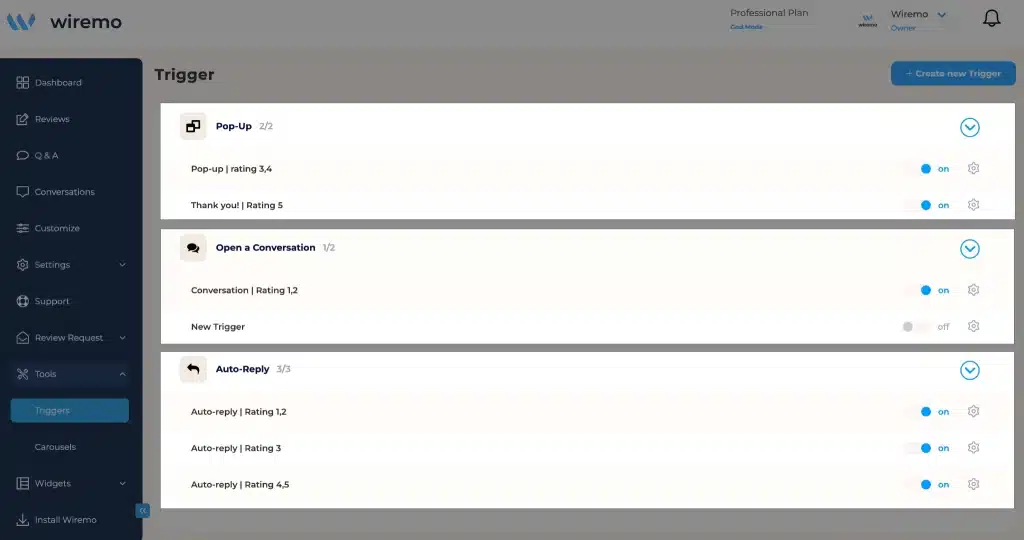
See how Wiremo's AI auto-reply works →
Running a Free Google Business Profile Audit with Wiremo
Before optimizing anything, run Wiremo's free Google Business Profile audit.
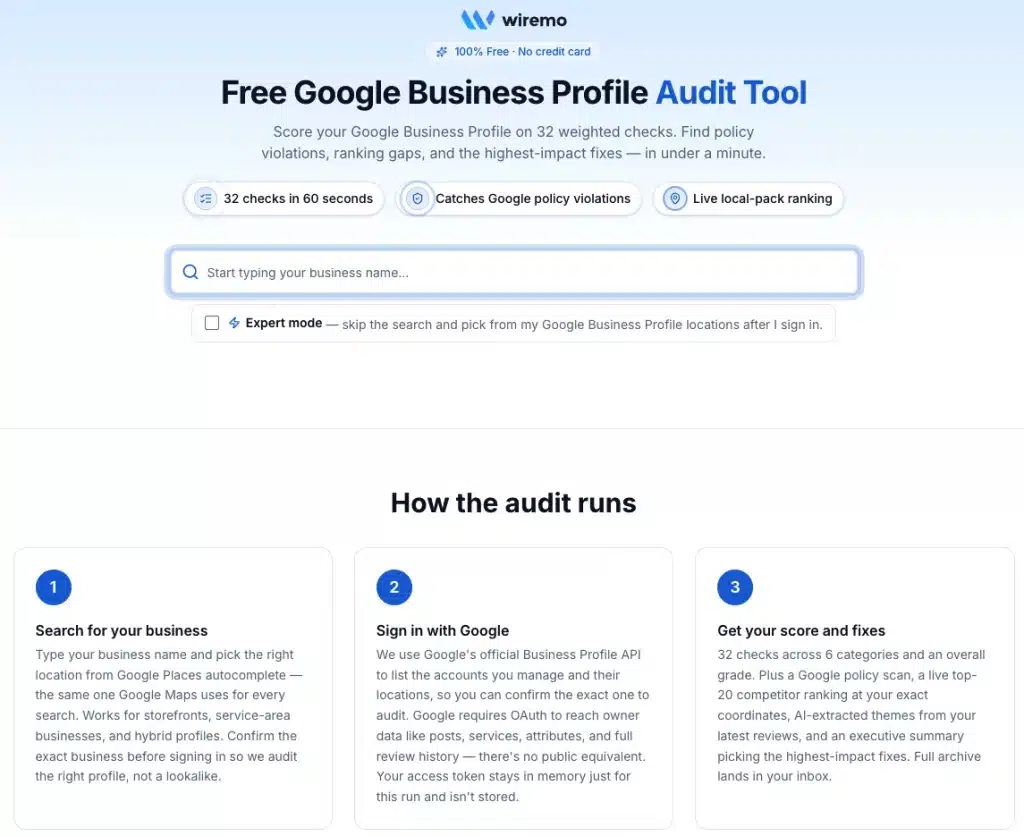
Sign in with Google, select your location, and the tool runs 32 weighted checks across six categories: profile fundamentals, categories and services, media, reviews and reputation, posts, and trust and attributes, returning an overall grade in under a minute. It also runs a Google policy scan that flags anything likely to trigger a suspension, pulls a live top-20 competitor ranking at your exact coordinates, and extracts AI-identified themes from your latest reviews.
The output tells you exactly where your profile is losing points and which fixes will have the highest impact. No guessing. Just a prioritized action list based on how your profile scores against real ranking benchmarks.
If you're managing one location and want to know where your GBP stands before touching anything else, Wiremo's free audit takes under a minute and tells you exactly what to fix first.
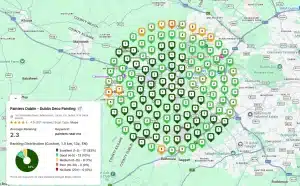
If you're managing multiple locations or clients, GTrack inside Wiremo gives you geo-grid tracking that shows where you're ranking neighborhood by neighborhood across every service area.
Embedding JSON-LD Structured Data So AI Search Engines Recommend You
AI search engines don't read your website the way humans do. They scan your code for JSON-LD markup, structured data that tells them exactly who you are, what you do, where you operate, and what your customers think. Without it, AI systems have to guess. Businesses that make them guess get skipped in favor of businesses that make it obvious.

Structured data like LocalBusiness Schema acts as a nutrition label for AI agents to understand your services and location. Wiremo generates JSON-LD structured data snippets that embed your star ratings and review data directly into your site's code.
When Perplexity, Gemini, or ChatGPT are deciding which local business to recommend, businesses with clean structured data have a significant edge. Wiremo handles this automatically, no developer required.
The Complete AI Local SEO Workflow
The businesses dominating local search run it as a system. Here's the execution sequence.
Step 1: Audit
Run Wiremo's free GBP audit, 32 checks, graded in under a minute. Fix what it flags.
Then run your website through an AI SEO tool to identify technical gaps: missing structured data, thin location pages, and slow mobile load speed.
Once audit fixes are done, GLocal by Wiremo handles ongoing GBP management automatically.
Step 2: Keywords
Use AI to generate hyper-local, conversational keyword lists for every service and neighborhood you target.
Organize by search intent. Identify competitor gaps.
Prioritize transactional queries first.
Step 3: Content
Build neighborhood-level supporting pages and long-form FAQ content using AI as your drafting tool.
Edit every output with real local detail, job examples, response times, landmarks, and pricing ranges. Publish on a consistent schedule.
Step 4: Reviews
Set up Wiremo's automated review triggers for immediate post-transaction requests. Configure AI-powered responses for all incoming reviews.
Check your Wiremo dashboard weekly and use sentiment analysis to surface new content opportunities from customer feedback.
Step 5: Structured Data and Tracking
Use Wiremo to embed JSON-LD structured data. Add LocalBusiness Schema to every location page.
Use tools like GTrack to monitor geo-grid local rankings across multiple service areas, particularly useful for multi-location businesses or agencies managing several clients.
How to Measure Whether Your AI Local SEO Strategy Is Working
Impressions are vanity metrics. Track the numbers that connect to revenue:
- Local pack rankings for primary keywords across each neighborhood you target
- Organic traffic to location-specific pages
- GBP actions: calls, direction requests, website clicks
These conversion data points tell you whether your local SEO strategy is driving actual business, not just visibility.
AI Citation Tracking and Google Business Profile Insights
Check your GBP insights weekly. Spot the search trends. If a keyword is suddenly driving more profile views, build more content around it.
For AI citation tracking, emerging tools now monitor whether your business is being recommended by ChatGPT, Perplexity, and Gemini, telling you whether your AI SEO work is paying off beyond traditional Google search results.
Analytics Tools Worth Using
- Google Search Console: keyword visibility and technical SEO issues
- Google Analytics: local organic traffic and conversion behavior
- Wiremo: review performance and reputation signals
- GTrack: geo-grid local rankings across multiple service areas, so you can see visibility gaps location by location and prioritize accordingly if you have multiple clients
You don't need a dozen tools. You need a few that each do their job clearly, and that you actually check consistently.
Conclusion
AI hasn't replaced local SEO. It raised the floor.
The businesses showing up in AI-powered search results in 2026 aren't doing something completely new. They're executing the fundamentals, consistent NAP data, active Google Business Profiles, deep local content, fresh reviews, at a level AI systems recognize and reward.
What's changed is the speed and scale required. Manual processes can't keep up. AI tools can.
Start with the audit. Fix the foundation. Build the content. Automate the reviews. Track the results.
The businesses that do this consistently are the ones that attract nearby customers, whether they're searching on Google, asking ChatGPT, or talking to their phone at 10 pm, looking for someone who can help right now.
That's the whole game.

Brandon Leuangpaseuth
Brandon Leuangpaseuth is an SEO growth marketer with 8+ years of experience helping B2B SaaS companies scale organically. He is the founder of Brandon Leuangpaseuth, LLC. Clients have included Y Combinator-backed startups and multimillion-dollar brands. Published in CXL, Clearscope, and Grow & Convert. Recognized by DesignRush, Clutch, and The Manifest.