TL;DR
Google reviews for business in 2026 are the single biggest organic-trust lever a local company controls. This playbook covers the 7 operator tasks every owner runs: why reviews matter and where they show, how to ask politely, how to respond (including the bad ones), what Google's policy says, how reviews drive local SEO, the mistakes that quietly kill velocity, and how to manage all of it at scale with a 30-day plan to start.
The average local business owner spends 4 hours a week on Google reviews and still feels behind. Half of that time is wasted because the operator does not have a clear playbook for what to do, in what order, and where the leverage actually is.
This pillar is the playbook. It walks through the 7 tasks that decide whether a Google Business Profile becomes a steady source of new customers or a slow leak of trust.
Why Google Reviews for Business Matter
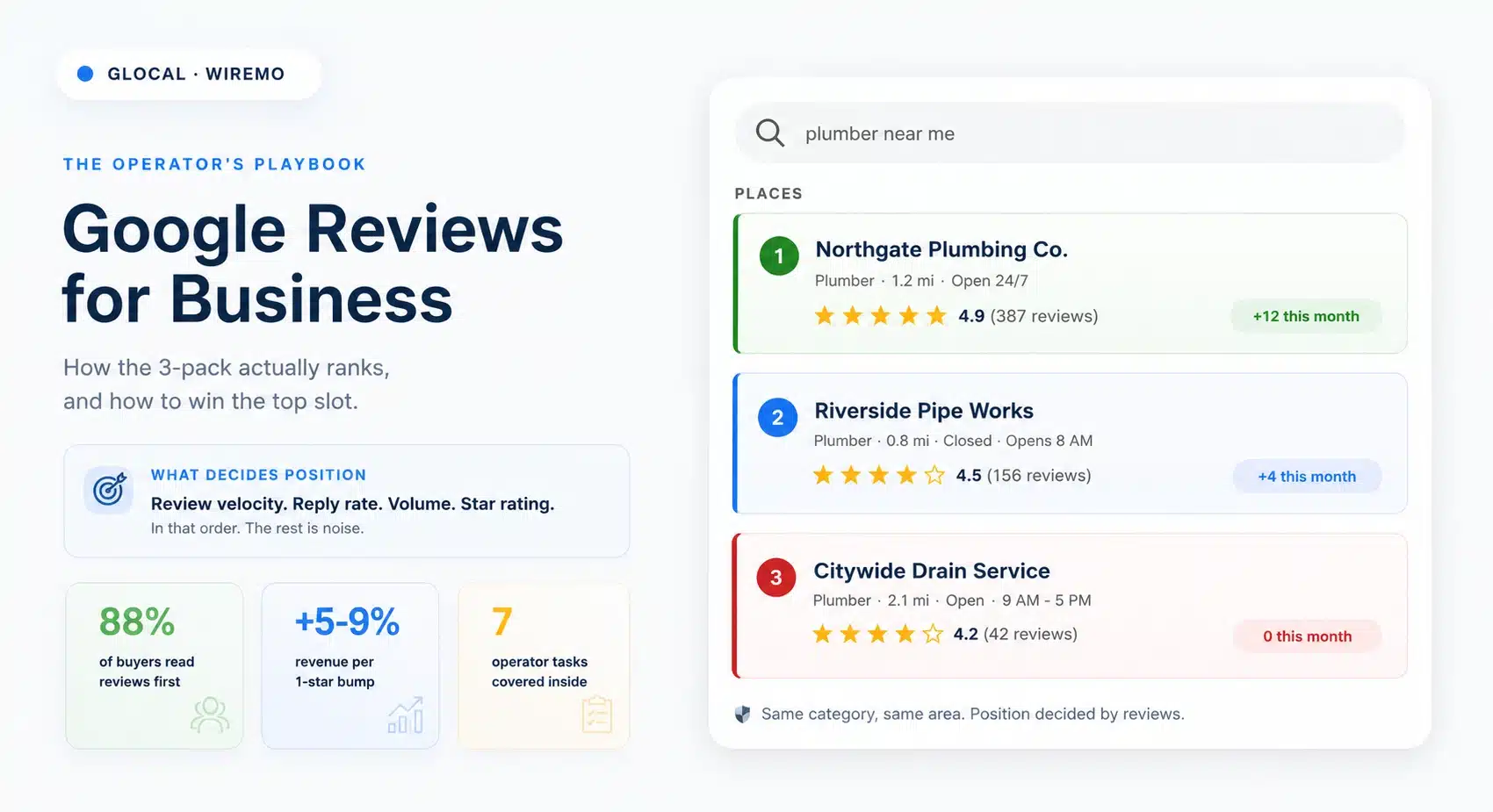
Google reviews now outrank every other digital trust signal a local business has, including its website, its social proof, and its years in business. The reason is simple: when a buyer searches for a service near them, Google shows the local pack (the 3-result map block) before anything else. Star count and review volume are the two visible numbers in that block. Buyers compare them in seconds.
Consumer-research data across the local-business space consistently puts the number around 88% of buyers as people who read online reviews before visiting a local business, with 75% specifically checking Google. The average buyer reads between 7 and 10 reviews before deciding. That is more depth than most owners realize when they read a single bad review and panic.
The revenue impact compounds. Multiple studies on local-business ratings have found a 1-star bump produces a 5-9% revenue lift. Modeling on Google reviews specifically shows a similar shape: moving from 4.0 to 4.5 stars roughly doubles the likelihood that a buyer in the local pack picks you over a 4.0 competitor a few blocks away.
The trust gap also widens with volume. A 4.8-star business with 500 reviews reads as established. The same 4.8 with 12 reviews reads as untested. Most local-pack winners now sit above 200 reviews. Owners stuck under 50 are competing with one hand behind their back.
88%
of buyers read reviews before visiting a local business
+5-9%
revenue lift per 1-star rating increase
200+
reviews most local-pack winners now carry
Where Google reviews show up
Google does not bury reviews. It surfaces them in five places: the local pack (the map block), the business profile panel (when someone searches your name), Google Maps (the fullest review view), Search rich results (star ratings in the blue links, when LocalBusiness schema is valid), and the knowledge panel (aggregated reviews for branded queries). Most owners optimize only for the panel because that is what they see when they search their own name. The local pack is where new customer revenue actually comes from. Optimize there first.
How to Ask for Reviews
The single largest mistake operators make is asking everyone the same way. Different customers respond to different channels, and the same customer responds differently at different points in their experience. The most effective review programs use 4-6 channels, not 1.
| Channel | Typical conversion | Best for |
|---|---|---|
| In-person verbal ask | 15-25% | Service finish moments, checkout |
| QR code on receipt or tent | 8-15% | Restaurants, retail, salons |
| Post-service SMS (2 hrs after) | 5-12% | Home services, dental, auto |
| Post-purchase email | 1-3% | E-commerce, B2B, agencies |
| Thank-you card with QR | 6-10% | E-commerce, florists, bakeries |
| NFC tap card at counter | 10-18% | Salons, cafes, repair shops |
The 2-hour SMS window is the highest-leverage moment most businesses miss. The customer's phone is in hand, the experience is fresh, and the link is one tap away. SMS conversion sits between 5% and 12% reliably. Email conversion at the same point in time runs 1-3% because the customer is not looking at email two hours after the visit.
The wording matters less than people think. A direct "If your visit was good, would you leave us a quick Google review here: [link]" outperforms long pleas and overly creative scripts. Customers know what you are asking. Make it easy to say yes.
A simple script that works across most service businesses: "Thanks for coming in today. If you had a good experience, I would really appreciate a quick Google review. Here is the link, takes about a minute." Hand over a printed card or text the link while the customer is still in front of you. The conversion rate of a verbal ask plus an immediate link transfer runs 20-25%, which is higher than any single digital channel.
For service businesses with a longer engagement (home services, dental, agencies), the moment to ask is at the end of the project's natural finish line, not in the middle. Asking too early sets up the customer to feel obligated. Asking at the genuine conclusion of value delivered feels earned.
One thing to never do: never offer a discount, gift, or refund in exchange for a review. That is a direct violation of Google's review content policy and a common cause of mass review removal events. Asking is fine. Trading is not.
Make sure your profile is set up to actually receive reviews before you start pushing. A free Business Profile audit takes 60 seconds and surfaces the basic configuration mistakes (wrong category, missing service area, inactive review tab) that quietly kill review velocity.
How to Respond to Reviews
Responding to reviews is the most underused lever in local SEO. Google's own help docs name response rate as a quality signal. Owners who reply to every review within 24 hours rank measurably higher in the local pack than owners who reply to none.
Replies by star rating
The response shape changes by star count. Here is the operator-level cheat sheet.
5 stars. Thank by name, name the specific thing they praised, and mention what you would love to show them on a return visit. Three sentences. Do not template-blast every 5-star with the same paragraph.
4 stars. Thank them, acknowledge the gap implicitly (without restating it), and invite them back. The goal is to convert the next visit into a 5.
3 stars. This is the most underused tier. A thoughtful response here often converts the customer to a 5-star review. Acknowledge specifically what went wrong, name what you are doing about it, and offer a direct contact path. Stay public, not defensive.
2 stars. Apologize without excuses. Acknowledge the specific issue. Offer to make it right. Provide a direct contact (owner's email, not a generic support line). Future customers reading this will judge the response, not the original review.
1 star. Same shape as 2 stars, but with more discipline. Resist the urge to argue facts in public. If the review is factually wrong, your response can correct one specific factual point, then redirect to private resolution. If the review is from a non-customer, your response can politely note that ("we have no record of this booking, could you reach out at [email] so we can verify?") without making accusations.
Critical
Never reveal private customer information in a public reply. No appointment confirmations, no health details, no transaction amounts. Even if the customer revealed it first, your response is a permanent public record.
Sample replies you can adapt
Four sample replies that show the shape, ready to adapt to your voice:
5-star reply
"Thank you, Maria! So glad the deep-cleaning service worked out for the move-out. Next time you book, ask for Lina, she remembers your dog is shy around vacuums."
3-star reply
"Thanks for the honest feedback, James. You are right that the wait was longer than it should have been on Saturday morning. We added a second stylist to that shift starting next week. Drinks on us next time, just mention this review at the desk."
1-star reply (real customer)
"I'm sorry the experience fell so short, Carlos. That is not the standard we hold ourselves to. Could you email me directly at owner@business.com so I can understand what happened and make it right?"
1-star reply (no record of visit)
"We take every review seriously, but we cannot find a booking under this name in our system. If we have made an error, please reach out at owner@business.com with the date of service so we can review."
Handling fake or extortion reviews
A small share of negative reviews comes from people who never bought from you. The reply should politely note the lack of a record without making the accusation public, then flag the review through the GBP dashboard with "Off topic" or "Conflict of interest" as the reason.
For competitor-planted reviews, evidence helps Google's removal team: a screenshot showing the same reviewer reviewing your competitor positively, or a public statement that proves intent. For outright extortion ("give me a refund or I leave a 1-star"), log the message, screenshot it, do not pay, and report through Google's escalation form. The FTC and state AG offices accept reports in serious cases.
Reply within 24 hours when you can, 72 hours at the outside. Google's own guidance on replying to reviews spells out the do-and-don't list. Businesses that reply within 24 hours have 12% higher conversion from local-pack impression to call. The pattern is real.
Google Review Policy 2026
Google's review policy is shorter than most owners think and stricter than most realize. Eleven content categories are flat-out prohibited. Here are the ones owners run into most.
| Violation | What it looks like |
|---|---|
| Off topic | Political opinions, personal grievances unrelated to the business |
| Conflict of interest | Owner-written reviews, employee reviews, competitor reviews |
| Incentivized content | Reviews exchanged for discounts, free items, or money |
| Spam and fake content | Bot-generated, duplicate, or paid-network reviews |
| Restricted content | Mentions of regulated products (firearms, tobacco, alcohol) in a promotional context |
| Personal information | Reviews that reveal another person's name, contact info, or address |
| Harassment | Personal attacks, threats, or hate speech |
The two most common owner-side violations are incentivized content (offering discounts for reviews) and conflict of interest (employees reviewing the business). Both can trigger a mass-removal event where Google strips not just the offending reviews but a much larger swath of recent ones. The blast radius is what makes the rule worth respecting.
When you spot a review that violates policy, flag it through the GBP dashboard with the matching reason. Google's first-pass review removes obvious cases. Escalation through the official form (linked from the dashboard) covers the harder ones. Allow 5-10 business days for a decision.
Google Reviews for Business SEO
Google reviews influence local SEO through three signals: total review count, average star rating, and review velocity. All three feed into the local pack ranking algorithm, though Google has never published the exact weights.
RELATIVE RANKING SIGNAL STRENGTH
Review-related factors that move the local pack in 2026
Relative weights based on field observation; Google does not publish exact algorithm weights.
Review volume
A higher review count generally correlates with higher local-pack rankings, but the curve is sub-linear. Going from 10 to 50 reviews matters far more than going from 500 to 1,000. The first 100 do the heavy lifting; the next 400 mostly serve trust at the buyer level.
Star rating
Rating influences rankings indirectly through click-through rate. A 4.7-star business in the local pack gets clicked more than a 4.1-star one in the same slot. Higher CTR is a measurable ranking signal across most of Google's systems.
Review velocity
This is the underrated one. A consistent five fresh reviews each month beats a stagnant 200-review pile from three years back. Google's local algorithm weights recent reviews more heavily, partly because they signal "still in business and active" and partly because they update the signal noise around a profile.
One signal owners often miss: keyword content in review text. When customers naturally mention what they came in for ("amazing emergency plumbing"), those words enter the profile's text signal and can lift you for searches that match. Do not script reviews to insert keywords. Design the customer experience so that the moment they want to mention is also the moment they would say the keyword.
Tracking the SEO impact takes more than the GBP dashboard. A local search rank monitor like GTrack shows your position across a geographic grid, not just at one point. Owners who watch the local pack from a single zip code miss the larger movements that reviews drive across a 10-mile radius.
Common Google Reviews Mistakes
Most local businesses that struggle with Google reviews are making one of seven common mistakes, all of which are correctable within a week. Avoiding these costs nothing and changes the trajectory of the profile inside a quarter.
Asking for reviews without testing the link first. A surprising percentage of owners hand out a review link they have never personally clicked. The link redirects to the wrong location, hits a sign-in loop, or asks the customer to choose between five duplicate listings. Always test the link on a phone you are not signed in on.
Replying to only the bad reviews. The reply rate signal Google watches is not your 1-star response rate; it is your overall response rate. Replying to every 5-star with a quick two-sentence thanks doubles your aggregate response rate and lifts the local-pack signal without much extra time.
Templated replies that paste the same paragraph under every review look worse than no reply at all. A reader can spot a templated thank-you in three seconds. Vary the structure, name the specific thing the reviewer mentioned, and keep the replies to three sentences max.
Ignoring the GBP profile category settings. Reviews from customers who searched a category that does not match your profile carry less weight in the local-pack ranking signal. If you fix one thing this month, audit your primary and secondary categories before you push more reviews.
Buying reviews from a freelance marketplace or review-network service. Detection technology has improved dramatically since 2024. Mass purchases now trigger pattern-detection sweeps that strip not just the bought reviews but a swath of legitimate ones from the same period. The reputational and SEO blast radius lasts months.
Setting up review-request automation without an unsubscribe path. A customer who gets the third "leave us a review" SMS from a business that already heard "no" is annoyed enough to leave a 1-star out of spite. One ask, one polite reminder seven days later if no response, then silence.
Letting the profile go stale visually while reviews come in. A business with 200 fresh reviews but no recent photos, no GBP posts in 60 days, and no Q&A activity reads as half-abandoned. Reviews are one signal; the rest of the profile has to keep pace.
Manage Reviews at Scale
One location with 20 reviews a month is a different problem than ten locations with 200 a month. The tools and workflows that get you from zero to fifty per month break at three hundred.
Single location, low volume. Check the GBP dashboard once a day. Respond within 24 hours. Use saved reply templates in your notes app. Total time: 15-30 minutes per day.
Single location, high volume (10+ per day). A dedicated review-management tool starts paying back. Centralized inbox, alert routing, reply templates, sentiment tagging. Owners spend 5-10 minutes per day at this point instead of 30.
Multi-location (3-30 locations). Required: per-location reply assignment, brand-voice templates with variable insertion, and aggregated reporting. The GBP dashboard does not scale here; logging in and out of locations destroys your day.
Enterprise (30+ locations). Add role-based access, regional approval workflows, sentiment-trend dashboards, and API-level integration with your CRM. At this scale, a single bad-review-handling miss is a brand-level event.
Most multi-location operators use a GBP autopilot tool like GLocal to centralize inbox management, schedule GBP posts in bulk, and route review replies to the right team member by location. For single-location operators focused only on the review side, a focused review feedback hub like Wiremo's review platform handles the inbox, AI reply suggestions, and weekly reporting without the broader GBP workflow.
The weekly review routine
A weekly routine that holds at any scale: Monday morning, scan the prior week's reviews and flag any that need owner attention. Tuesday through Friday, reply to new reviews within 24 hours (daily 5-10 minute block). Friday afternoon, review the week's request-to-post conversion rate by channel and tweak the asks for the next week. Monthly, audit which placements (receipts, SMS, QR cards) are producing the most reviews and reallocate effort accordingly.
Your first 30 days
Week 1: audit and clean up. Run a free GBP diagnostic. Fix the structural issues: wrong primary category, missing service area, duplicate listings. Note your starting numbers and pick two channels to activate.
Week 2: build the assets. Generate your review link. Create the QR code. Draft your SMS template and verbal script. Test every asset on a phone before deploying.
Week 3: ask everyone. Train every team member on the verbal ask. Send the SMS to every customer who completes service that week. Goal: 10-20 new requests sent.
Week 4: respond and adjust. Reply to each new review within 24 hours. Track channel conversion. Double down on what works, drop or improve what does not.
One workflow rule that scales at every size: never let a review sit unanswered for more than 72 hours, even at 500 reviews a month. The 24-72 hour window is where the SEO and trust impact lives. Anything older than that is documentation, not engagement.
Google Reviews for Business FAQ
How many Google reviews do I need to compete in the local pack?
Most local-pack winners now sit above 200 reviews. The minimum to be competitive in moderately contested categories is 50-100. Below 25 you are at a structural disadvantage, no matter how good your rating.
How much does it cost to get Google reviews?
The reviews themselves are free, and buying them is a direct policy violation. The real cost is the tooling: a review-request SMS service runs $30-100/month, a multi-location review-management platform runs $50-300/month per location.
Can a business respond to reviews anonymously?
No. Business replies always show the business name and verified owner badge. The reply is part of your public Google Business Profile, not a private message.
How do I remove a fake Google review?
Flag it through the GBP dashboard with the matching policy reason (Off topic / Conflict of interest / Spam). If Google rejects the first flag, escalate through the official form linked in the GBP help center. Average resolution time runs 5-10 business days.
Do Google reviews really help local SEO?
Yes. Volume, rating, velocity, and response rate all influence local pack rankings. The strongest single signal in 2026 is review velocity (fresh reviews per month) followed by response rate within 24 hours.
What is the difference between Google reviews and Google Business Profile reviews?
They are the same reviews, accessed from different surfaces. Google Maps, Google Search, and the Business Profile dashboard all show the same review feed. The naming difference is purely Google's branding.
Can I delete a Google review I posted as a customer?
Yes, customers can edit or delete their own reviews from the Maps app or business.google.com. Owners cannot delete customer reviews directly; they can only flag them for Google's review.
How long do Google reviews last?
Forever, with the algorithm weighting them less over time. Reviews older than 13 months still count toward your average but carry less SEO weight than fresh ones.
What if my reviews suddenly disappear?
Three common causes: Google's spam filter swept them, your profile was merged with a duplicate listing (check for duplicates), or you triggered a mass-removal event by violating policy. Resolution path: flag the disappearance through the dashboard and escalate if no response in 7 days.
Should I use AI to write review replies?
Cautiously. AI can draft a first pass that you edit. Sending raw AI-generated replies at scale is detectable and reads as cold. The current best practice is human-edited AI drafts, which cut response time by 60-70% without losing voice.
What other free tools should I use?
A free SEO tool library covering audit, schema, citations, and rank checks rounds out the review side. Reviews are one signal among ten that decides your local visibility.