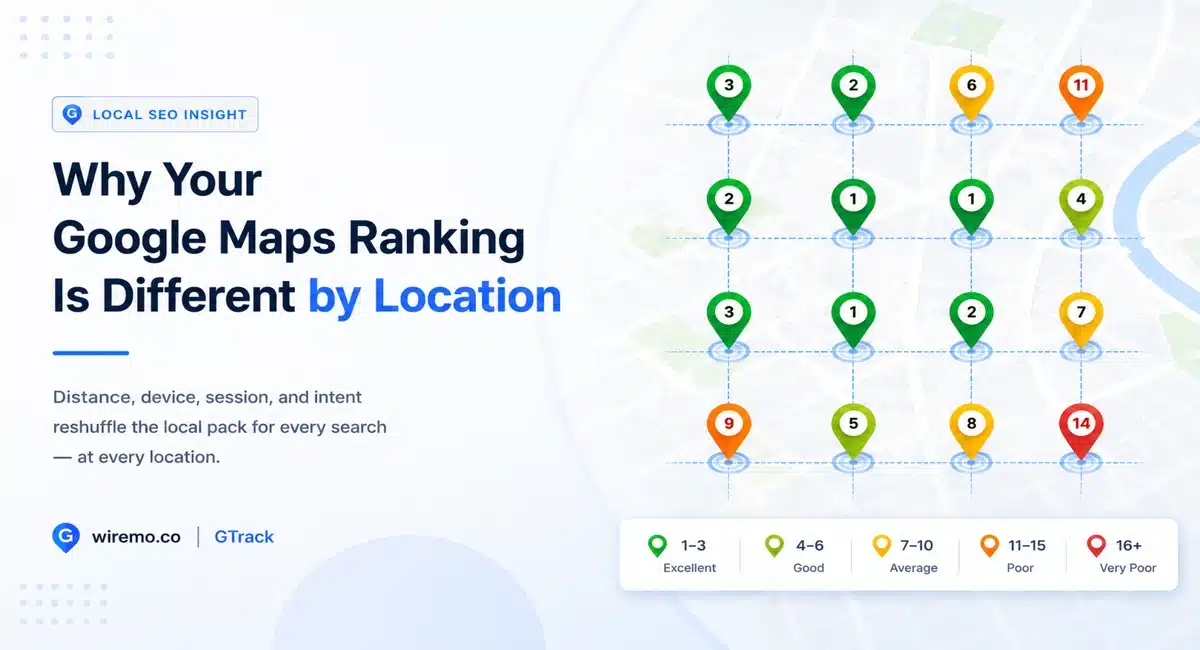
Search "plumber near me" from your office, and you might see your business at #3. Drive ten blocks away, search again, and you could be #11. Same business, same keyword, same minute. Your Google Maps ranking changes by location because Google doesn't store one fixed number for your business. It builds a new ranking every time someone searches, using inputs that change for every customer. Two customers across the street from each other can see two different local packs. The same customer searching from their phone at 9 a.m. and from their laptop at 9 p.m. can see two more.
Most local SEO advice treats Google Maps ranking like a single number you can move up or down. That model is wrong, and acting on it is why so many local businesses do "everything right" and never see the rankings they expect. Google Maps ranking changes by location, by device, by session, and by intent. The score you see in any one place is one slice of a much wider distribution.
This guide explains the five inputs Google actually uses to assemble the local pack for each searcher, why your "ranking" is more like a probability distribution than a number, and how to audit your visibility from your customers' perspectives instead of your own.
Key takeaways
- Google Maps ranking is a distribution, not a number. Every search returns a freshly calculated local pack.
- Five session-level inputs reshuffle the pack between customers: GPS coordinates, device class, search session context, personalization, and query intent.
- For most service-area businesses, hundreds to thousands of distinct ranking values exist for a single keyword across one city in a single day.
- Auditing your ranking by sampling, not by reading averaged metrics, is the only way to see what customers actually see.
Your Ranking Is a Distribution, Not a Number
When a customer types a query into Google Maps, Google does not look up "your rank" from a stored value. It runs a query that's specific to that exact person, in that exact session, at that exact moment. The local pack returned to them is custom-assembled from a candidate set of nearby businesses, scored against the searcher's signals, and sorted.
Run that process 1,000 times for 1,000 different searchers in your city, and you get 1,000 slightly different local packs. Some put your business at #1. Some put you at #14. Some don't include you at all. None of them is "your real ranking." They're all your real rankings, plural. The short answer to why Google Maps ranking changes by location is that there is no central ranking to begin with: each search produces its own.
Statistically, this means your ranking for any keyword is best understood as a distribution: a histogram of where you land across all the searches that match the query in your service area. The mean of that distribution is what reporting tools usually surface. The variance, or how spread out your positions are, is where most of the actionable signal lives.
A business with a mean position of 6 and tight variance (positions 4-8 across 95% of searches) is ranking consistently. A business with the same mean position 6 but wide variance (#2 in some sessions, #18 in others) has a very different problem and a very different fix.
The Five Variables Behind Every Single Search
Five inputs explain why Google Maps ranking changes by location and across every searcher, and they carry the most weight in determining what each customer sees.
1. Searcher GPS Coordinates
The customer's precise location at the moment of search. Google reads the GPS sensor on mobile devices and infers location from IP and Wi-Fi networks on desktops. A move of even a few hundred meters can change which businesses appear in the candidate set.
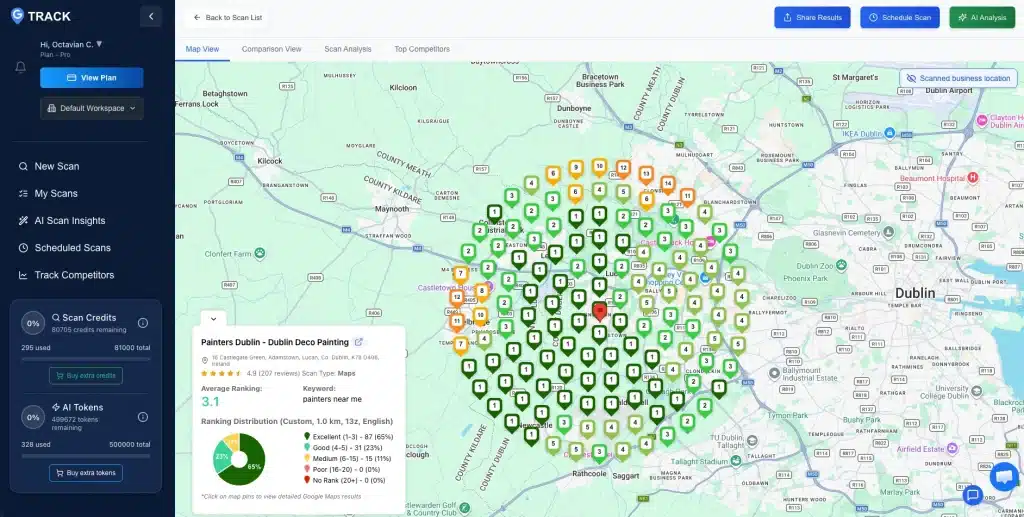
This is the variable everyone knows about. It's also why a 9×9 grid scan returns 81 different rank values for the same keyword.
2. Device Class and Capability
Mobile and desktop don't always show the same local pack, even from the same coordinates. Mobile results lean heavily on proximity and tap-to-call signals; desktop results sometimes show a wider radius and place more weight on review count and website signals.
The mobile-vs-desktop gap is most pronounced for service queries with strong proximity intent ("near me," "open now"). For research-stage queries ("best Italian restaurant"), the gap narrows because Google weights review depth and content signals more heavily across both surfaces. Google's local ranking factors confirm that proximity, relevance, and prominence interact differently for different intents.
3. Search Session Context
Time of day, day of the week, and whether the searcher just searched for something related all influence the local pack. A query for "coffee shop" at 9 a.m. on a weekday weighs open-status and morning-hours signals differently than the same query at 9 p.m. on a Friday. A "yoga studio" search five minutes after a "smoothie bar" search inherits a small amount of session intent.
Most local businesses never think about this dimension. The same customer can see your business at #3 in the morning and #9 in the evening simply because the rest of the candidate set is being weighted differently. Catching it means sampling rankings across multiple sessions, not reading a single averaged number once a month.
4. Personalization Signals
Search history, places visited, businesses interacted with previously, account language, and saved preferences all feed personalization. Two searchers standing on the same street corner with the same query can see different local packs because Google has more behavioral data on one of them than the other.
This is partly why incognito searches return different results than your everyday searches: incognito strips the personalization layer but keeps the others. It gives you a "default user" view, not a customer's actual view.
5. Query Intent Classification
Google classifies queries into intent categories before ranking. "Plumber" is a service category; "emergency plumber" is the urgency variant; "cheap plumber" carries a price modifier; "24-hour plumber" inherits time-sensitivity. The categories, services, and attributes on your Google Business Profile decide which intent variants you compete in, which is why most local businesses need to update the GBP services list and category attributes the moment they realize they're missing entire query variants.
If a competitor's profile says "24-hour service" and yours doesn't, you'll never rank for the urgency-variant queries no matter how close you are. That's not a proximity gap. It's an intent classification gap, and it's invisible from any ranking number you'd look at by default.
How Google Maps Ranking Changes by Location, Device, and Session
Combine those five variables and the math behind why Google Maps ranking changes by location gets aggressive fast. For a single keyword in a single city, conservatively:
- ~50 distinct GPS zones a customer might search from
- 2 device classes (mobile, desktop)
- 4 broad time-of-day windows that meaningfully shift weighting
- ~3 personalization tiers (anonymous, light history, heavy history)
- ~5 intent variants the keyword may resolve to
That's 50 × 2 × 4 × 3 × 5 = 6,000 distinct ranking states for one keyword in one city in one day. Not 6,000 customers, just 6,000 unique combinations of inputs that could each produce a different position for your business.
The actual number of customer searches your business is exposed to in a day is much smaller than 6,000 (most local businesses see hundreds, not thousands). The point is that the ranking outcomes those customers see are drawn from a probability distribution, not from a single fixed number, and your local SEO has to be tuned to a distribution rather than a point.
Three Patterns That Show Up in the Real World
Three short cases that illustrate how Google Maps ranking changes by location, by device, and by intent variant in practice.
The Cafe Owner in Seattle
Devon owns a cafe on Capitol Hill. He'd been "checking his ranking" by searching "coffee near me" from inside the cafe on his iPhone, where he consistently saw himself at #1. When his daughter searched the same query from the bus stop two blocks away on her Pixel, he showed up at #6. Same minute. Same query. Different position. The candidate set was identical; the device-class and GPS combination weighted that set differently.
The lesson he'd been operating on, "I'm #1 for coffee near me," was true for him and false for the customers he was actually competing for. Devon's case is the simplest version of how Google Maps ranking changes by location and device: the same business, the same minute, two different positions.
The Boutique Fitness Studio in Austin
Priya runs a single-location pilates studio. Her ranking from a sample of grid points was stable in the morning but degraded sharply between 6 p.m. and 9 p.m. Same address, same hours, same competitors. The reason turned out to be temporal: her competitors offered evening classes and ran weekly Google Business Profile posts about them, while Priya only ran morning sessions and never posted about them. In the evening, "yoga and pilates near me" surfaced businesses with active evening signals more aggressively. The fix was a single recurring post and an updated services list. Within six weeks, the evening drop disappeared.
The Chiropractor in Tucson
Robert had ranked at #4 for "chiropractor Tucson" for over a year, give or take a position. When he started tracking variants, the picture changed: he was #4 for the broad query, #2 for "back pain chiropractor," and #19 for "sports injury chiropractor." His business handled all three, but his Google Business Profile services list only included two of them. Adding "sports injury rehabilitation" and "athlete recovery" as services moved him from #19 to #5 in that intent variant within four weeks. He'd been losing those customers for over a year because the intent classification entirely removed him from the candidate set. Running his service list through a tool that can map every keyword variant of his services would have surfaced this gap from day one.
How to Audit Your Rankings Through Each Customer's Eyes
The right way to think about local SEO measurement is sampling: take enough samples across enough variables to estimate your distribution, then act on the variance. Sampling is the only honest way to see how Google Maps ranking changes by location for your real customers. Three sampling habits give you most of the value.
- Spatial sampling. Run a grid scan across your service area for each tracked keyword. The grid points correspond to GPS variable #1 and show directly how Google Maps ranking changes by location across your city. Look at the distribution of positions, not just the average.
- Temporal sampling. Run the same scan at three different times (morning, midday, evening) for at least one week. If your evening positions consistently lag morning positions, you have a session-context gap to investigate.
- Variant sampling. Track the 4-5 most plausible intent variants of your primary keyword separately. Your variance across variants will reveal classification gaps that grid scans alone miss.
None of these requires a tool more complex than a rank tracker that can run a grid scan across your service area and across intent variants. What they do require is treating your ranking as something to sample, not a number to look up.
What This Means for the Way You Run Local SEO
Once you accept that Google Maps ranking changes by location and session for every customer, the standard playbook shifts in several ways.
You stop chasing a single number and start managing variance. Two businesses with the same mean ranking can have wildly different traffic if one of them has tight variance and the other doesn't. Because Google Maps ranking changes by location and session for each searcher, reducing variance (making sure you rank consistently rather than spectacularly in some sessions and invisibly in others) is often a faster ROI lever than improving the mean.
You stop assuming your competitors are static. The candidate set Google considers for each query is itself dynamic. A competitor that wasn't a threat last quarter can become one because they updated their services list, started running posts, or shifted hours. Auditing the local pack you appear in, not just your position, is how you spot these shifts.
You stop optimizing only for relevance and prominence. Those matters, but the variables that change session-to-session are mostly about how Google reads the inputs of each search. Updating your Google Business Profile for hours, services, and attributes is what lets you compete in the right intent variants. Audit which of those fields you have populated and which you have left blank, because the blank ones are silently disqualifying you from query variants you should be winning.
For the algorithm side specifically, Google's own documentation on how to edit your Business Profile is the most reliable starting point. Accuracy and freshness of hours, services, and attributes feed directly into the per-search calculation we've been describing.
Frequently Asked Questions
1. Why does Google Maps ranking change by location and device?
Mobile results weight proximity, tap-to-call, and "open now" signals more aggressively than desktop results. The same business viewed from the same coordinates can rank one or two positions higher on mobile if it has strong proximity-relevant signals (verified hours, distance, directions count). The gap is largest for queries with explicit urgency or proximity intent, which is one of the main reasons Google Maps ranking changes by location and device at the same time.
2. Does my Google Maps ranking change at different times of day?
Yes, particularly for businesses where hours of operation matter (restaurants, services, retail). Open-status, recent posts, and freshness signals are weighted into the ranking calculation for each search. A business that's open late and posts about evening events will rank better in evening searches than a business with the same overall metrics that closes at 5 p.m.
3. If I rank #1 in incognito, do I rank #1 for everyone?
No. Incognito strips personalization but keeps the other four input variables (GPS, device, session, intent). It shows you a default-user result for one location at one time on one device. Customers searching from different locations, devices, sessions, or with personalized history will see different rankings.
4. How do I know which intent variants my business should rank for?
Start with the services your business actually offers, then map each one to the queries customers might use. A pediatric dentist should rank for "pediatric dentist," "kids dentist," "children's dentist," and "family dentist" if they serve all four. Each variant is its own ranking distribution. Tracking them separately reveals classification gaps that average rankings hide and shows how Google Maps ranking changes by location and intent variant simultaneously.
5. What's the practical difference between mean rank and rank variance?
Mean rank tells you "where you usually appear." Rank variance tells you "how unpredictable that is for any given customer." High variance with a good mean means you sometimes do well and sometimes don't show up at all. A worse customer experience than a slightly lower mean with consistent results. Optimizing for low variance is often more valuable for service-area businesses than chasing a higher mean.
Stop Treating Your Ranking Like a Number
The "single ranking" model of local SEO is convenient, easy to report on, and wrong in ways that cost you, customers. Google Maps ranking changes by location more aggressively than most owners realize, and your real visibility is a distribution shaped by GPS coordinates, device class, session context, personalization, and intent: five inputs that change between every customer search and turn a single keyword into thousands of distinct ranking outcomes per day.
Once you start managing for the distribution instead of the mean, the levers change. Lower variance often beats a higher mean. Intent variants matter as much as proximity, and session context becomes a design surface, not a noise floor.
Sample widely, audit your Google Business Profile fields against the intent variants that matter, and stop trusting any single number to describe what your customers actually see. Once you understand how Google Maps ranking changes by location for every searcher, you stop measuring the wrong thing.