

TL;DR: The Short Answer in Six Lines
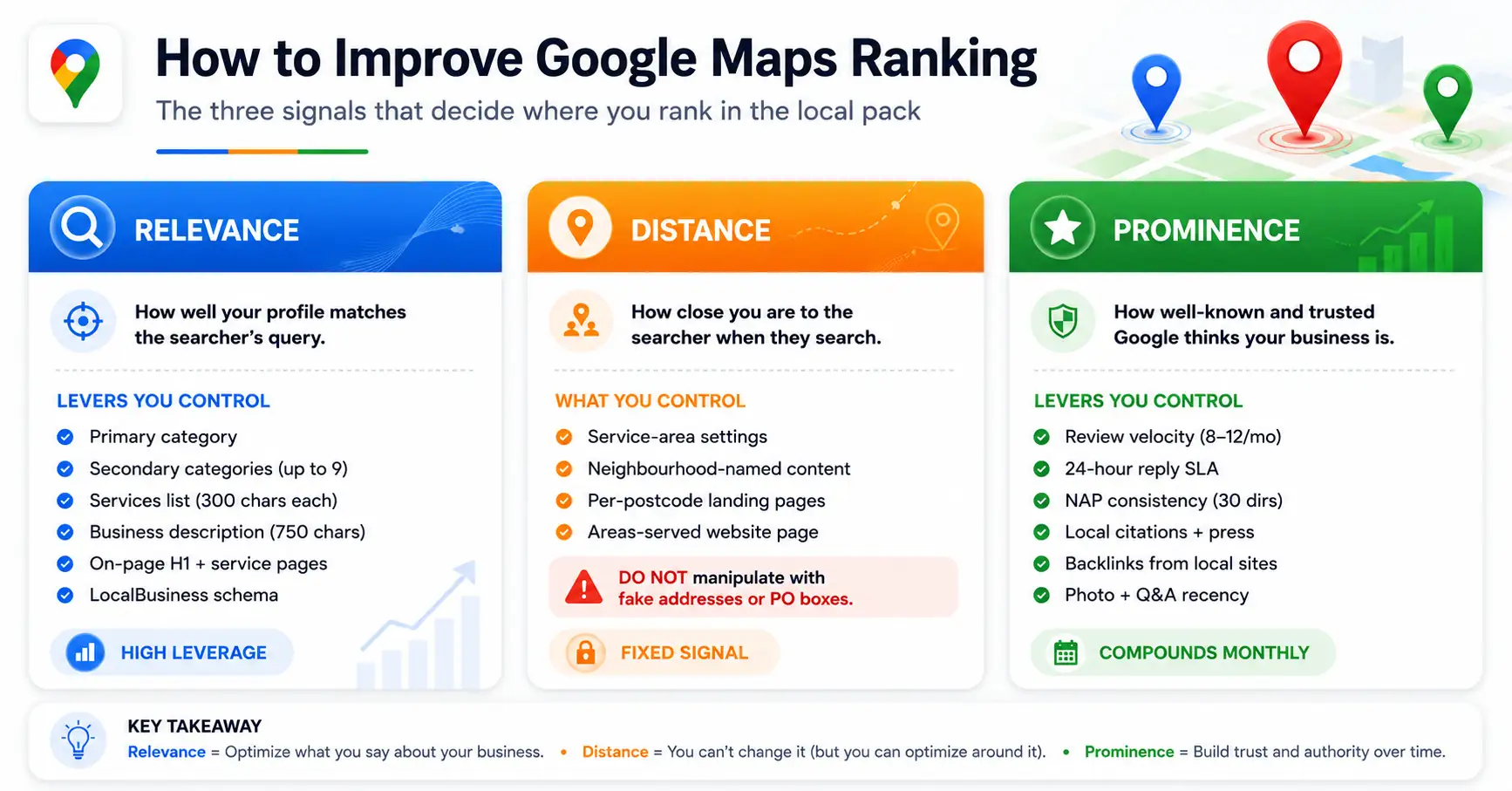
- Three signals decide every Maps ranking: Relevance, Distance, and Prominence. Two are levers, one is fixed.
- Profile completeness is the cheapest gain: primary category, services, attributes, Q&A, photos, in that order.
- Velocity beats volume on reviews: 8 to 12 fresh reviews per month, every one replied to within 24 hours.
- NAP consistency is non-optional: identical name, address, phone across your top 30 directories.
- On-page work sets the ceiling: city plus service in the H1, a service page per offering, LocalBusiness schema.
- Measure on 30-day cycles: the local pack moves in two to four-week waves. Weekly scans are noise.
How to Improve Google Maps Ranking is the question every local business owner ends up asking the moment they realise their competitor is sitting in the local pack and they are not. The honest answer is that Maps ranking is not magic and it is not luck. It is a public scoring system Google has documented for years, and every gain you can make comes from understanding what the system actually reads. This guide is structured as the questions owners ask, in the order they ask them, with the direct answer to each one. Read it top to bottom on a Sunday afternoon, and you will leave with a 30-day plan you can run on Monday.
What actually decides where you rank on Google Maps?
Three signals do all the work: Relevance, Distance, and Prominence. Google's own local ranking documentation names these three and lists nothing else. Every tactic in every local SEO guide is a way of moving one of those three numbers.
"If you only remember one thing about Google Maps ranking, remember the three words: Relevance, Distance, Prominence. Everything else is implementation detail."
Side by side, here is what each signal actually means and what you can do about it:
| Signal | What it means | What you control |
|---|---|---|
| Relevance | How well your profile and website match the searcher's query. | Primary category, services, description, schema, site copy. |
| Distance | How close you are to the searcher when the query is made. | Almost nothing. Your address is fixed. Service-area settings help at the margins. |
| Prominence | How well-known and trusted Google thinks your business is. | Review velocity, citations, on-page authority, press mentions, links. |
If a tactic does not change one of those three columns, it is a hobby, not a ranking strategy. Every question about How to Improve Google Maps Ranking is really a question about which column you are moving and by how much.
Relevance: the signal you have the most control over
Relevance is what your profile and website tell Google about who you are and what you sell. It is the only signal you can move quickly. Every field you complete on your Google Business Profile (primary category, secondary categories, services, business description, attributes) is a Relevance vote. Most profiles are five to ten edits away from a meaningful Relevance gain.
Distance: the signal you cannot move
Walk three blocks south of your business and search the same query. The local pack will change. The top three results will be different businesses, often businesses with weaker profiles than yours. The reason is Distance. Google weighs it heavily because users searching on a phone almost always want something near them right now.
⚠️ Critical Warning: Listing fake addresses, mailbox rentals, or co-working spaces as "extra locations" to manipulate Distance is a hard suspension trigger. The verification system catches this pattern routinely, and the cost of a suspension is two to eight weeks of zero visibility while you re-verify.
The right response to Distance is not to fight it but to map it. Run a grid scan with our local rank tracker tool to see exactly where your visibility drops off across the postcodes you want to win. The grid does not move Distance for you, but it tells you which neighbourhoods need extra Relevance and Prominence work to overcome the distance penalty.
Prominence: how Google measures local trust
Prominence is the slowest signal and the highest-ceiling one. It is built from review velocity, citation consistency, links from local press and local sites, mentions on chamber-of-commerce pages, and the overall on-page authority of your website. None of these moves in a week. All of them compound month over month. Treat Prominence as a one-year project that you start today.
How do you audit your Google Business Profile in 15 minutes?
When owners ask How to Improve Google Maps Ranking on a budget, the answer almost always starts here. The fastest, cheapest lift in local ranking is finishing your Google Business Profile properly. Most owners spend ten minutes on it once, declare it "done," and never touch the fields that actually influence Relevance. A 15-minute audit will find more low-hanging fruit than any tool you can buy.
Set your primary category first
Your primary category is the single highest-leverage Relevance signal on the profile. Pick the most specific category that matches your highest-value query. "Plumber" beats "Contractor." "Cosmetic Dentist" beats "Dentist." The right primary category alone can lift you two to five positions in the local pack within a single ranking cycle.
After the primary, fill out up to nine secondary categories. Each one is a separate searchable surface, and most profiles only use two of the nine available slots.
Fill in services and description thoroughly
The services list and business description are the next two highest-leverage fields. Add every service you offer as a separate entry, each with a 300-character description. Bundled paragraphs leave a searchable surface on the table. The business description allows 750 characters: put your primary keyword in the first sentence and name the neighbourhoods you serve explicitly.
Google's profile editing guidelines are explicit that every field you complete is a Relevance signal the algorithm reads when matching profiles to queries. Empty fields are missing votes.
⚠️ Critical Warning: Never add keywords to your business-name field (for example, "Acme Plumbing | Best Plumber in Limerick"). Google's name-stuffing policy treats this as a hard violation. First detection means suspension; recovery takes weeks. Put keywords in the description and services fields, not the name.
Photos, Q&A, and the recency signal
Profiles with at least 20 photos and two to three fresh uploads per month rank better than profiles with the same number of stale photos. Google weights recency. The same is true for the Q&A surface, which most owners ignore entirely. Seed five to ten owner-authored question-and-answer pairs from a customer's point of view, then monitor and respond to new questions within 24 hours.
✅ The Fix: Block 90 minutes this week to complete every empty or weak field. If you manage profiles for more than one location, our Google Business Profile software centralises every field, post, and review reply so the work scales past the first location.
What does a high-leverage review strategy look like in 2026?
Two businesses sit on the same street. One has 500 lifetime reviews, all from 2019 and 2020. The other has 80 reviews and earns 10 fresh ones every month. The second outranks the first because Google weights recency far more heavily than raw count. Volume is a vanity metric. Velocity is the signal.
"A 5-star review from last month is worth ten 5-star reviews from 2019. Build a system that produces reviews on a cadence, not a campaign."
Why velocity matters more than volume
Recency is a freshness check on the trust signal. Google reads a recent review as live evidence that the business is operating, serving customers, and earning satisfaction now. A profile with 200 reviews from three years ago and zero in the past 12 months reads as a business in decline, even if it is thriving offline. The fix is not to delete old reviews. It is to add new ones on a steady cadence that signals current activity.
Realistic monthly review targets
| Business Type | Monthly New Reviews | Response SLA |
|---|---|---|
| Single-location service business | 8 to 12 | Within 24 hours, every review |
| Multi-location franchise | 15 to 25 per location | Within 24 hours, every review |
| High-volume retail or restaurant | 30 to 50 | Within 24 hours, AI-assisted at scale |
Before you commit to a target, plug your current numbers into our review star calculator and see exactly how many fresh reviews it takes to move your average to where you want it. The number is almost always smaller than people expect.
How to ask, reply, and surface keywords in responses
Ask for the review in person, the moment service is delivered. Put a QR code on every invoice that opens your Google review link directly. Reply to every review within 24 hours, including 5-star ones, and name the service performed in the reply so the review itself carries your target keywords.
⚠️ Critical Warning: Mass email blasts a week after service convert at 5 to 10 percent. Google's review policy also bans incentivising reviews with discounts or perks, even subtle ones. Both shortcuts underdeliver and risk a policy violation that wipes the reviews you do collect.
How do you keep your NAP consistent across 30 directories?
Your business name, address, and phone number sit on dozens of directories. Each one is a trust signal Google uses to confirm your business is real and where you say you are. The moment those entries start to drift (a different phone format on Yelp, an old address on Bing Places, a missing "Ltd" on the chamber of commerce site), the trust signal weakens, and your ranking ceiling drops with it.
The 30-directory baseline that matters
- Google Business Profile (the master record; everything else mirrors it).
- Bing Places, Apple Maps, Yelp, Facebook Business Page.
- Regional directories: Yell.com, GoldenPages.ie, ThomsonLocal, Foursquare.
- Industry-specific directories: CheckATrade, MyBuilder, Houzz for trades; OpenTable, TripAdvisor for hospitality.
- Local chamber of commerce, local newspaper business listings, and regional council registers.
One canonical format, applied everywhere
The decision that prevents drift is to pick one canonical format and apply it everywhere. Decide once whether your street is "Street" or "St.," whether your phone is "+353 1 234 5678" or "01 234 5678," and whether your name ends with "Ltd" or not. The inconsistency hurts you. The choice itself does not.
✅ The Fix: Build a one-page NAP document with the canonical format. Audit the top 30 directories quarterly and correct any drift in a single sitting. This is the most underrated 60-minute task in local SEO, and it pays compounding interest the longer your profile lives.
What on-page signals does Google actually read for local ranking?
Profile work has a ceiling. Once your profile is finished, the next gain comes from on-page signals on your own website. Most local businesses run a homepage that reads "Welcome to [Business Name]" and stop there, while their competitors run a homepage that reads "[Service] in [City] | [Business Name]." Google reads the second version and not the first.
Homepage H1: service plus city
Your homepage H1 is the highest-weighted on-page signal Google reads. "Welcome to Acme Plumbing" becomes "Plumber in Limerick: Acme Plumbing on the South Circular Road." The service and the city need to appear in the H1, the meta title, and the first paragraph of body copy. Make this change first; it is the single highest-leverage on-page edit.
Service pages and areas-served pages
Build one page per primary service, each with the service name plus city in the H1 and meta title. Do not pile every offering onto a single page. Add an areas-served page that names every suburb or neighbourhood you cover, with one paragraph of context per area. Each service page and each area paragraph is a Relevance vote for the exact query that combines that service with that city.
LocalBusiness schema markup
Structured data on the homepage and every service page gives Google machine-readable confirmation of what you are and where you are. Use our local schema generator to produce valid LocalBusiness JSON-LD in seconds, then paste it into the head of the relevant pages.
"A strong profile linked to a weak website ranks below the same profile linked to a strong local site. The website is not optional."
⚠️ Critical Warning: Adding schema markup with inconsistent data (a different address from your profile, a different phone number, a mismatched business name) does more harm than good. Schema must mirror your canonical NAP exactly. Validate before you deploy.
How to Improve Google Maps Ranking in Your Next 30 Days
The whole playbook for How to Improve Google Maps Ranking fits inside one calendar month. Pick the single head keyword you want to own. Run a baseline grid scan today and save the screenshot. Block 90 minutes this week to finish every empty field on your Google Business Profile. Decide your monthly review-velocity target and put a QR code on every invoice starting tomorrow. Audit your top 30 directories for NAP consistency on Saturday. Rewrite your homepage H1 and ship the first dedicated service page before the end of the month.
How often to scan the grid, and when to act
The local pack moves in two to four-week cycles for most queries. Weekly scans capture random noise. Monthly scans capture real directional movement. A 90-day window of three scans (day 0, day 30, day 60) is enough to know whether the playbook is working or whether you need to revisit a step. Do not change strategy based on a single bad scan inside a 30-day window. Wait for the next monthly scan to confirm direction.
Your 30-day cadence
Set a recurring calendar reminder for a 30-day grid scan on the same keyword, same grid size, same centre point. Compare each scan to the previous one. Real progress shows up as red points turning yellow, and yellow turning green. Run the first scan now with our geo grid scanner, and re-scan on the same date next month. How to Improve Google Maps Ranking is not a one-time project. It is a 30-day cadence you run forever.
Frequently Asked Questions About Improving Google Maps Ranking
How long does it take to see results from Google Maps SEO?
Most businesses see the first measurable lift on day 30 after a complete profile audit and the first wave of citation cleanup. A meaningful grid shift (red points turning yellow, yellow turning green) shows up between day 60 and day 90. Established businesses in competitive metros typically need 6 to 12 months of consistent monthly work to land top-3 positions for high-value queries. If you have done nothing on your profile in two years, expect the day-30 lift to be larger than you expect; the cheap wins compound quickly.
Do paid Google Ads improve organic Google Maps ranking?
No. The organic local pack and Local Services Ads run on separate systems. Paid spend does not lift organic ranking, and pausing your ads does not drop it. Ads can fill your calendar while you build organic ranking, but the two channels do not feed each other. Treat them as parallel investments with different break-even windows.
Does my website even matter, or is the profile enough?
The website matters more than most owners realise. On-page signals (service plus city in the H1, dedicated service pages, LocalBusiness schema, page-speed) feed Google's Relevance scoring directly. A strong profile linked to a weak website ranks below the same profile linked to a strong local site. The profile is the floor; the website is the ceiling.
What is the right grid size for my business?
Three sensible defaults work for almost every local business:
- 5x5 at 0.20 mi spacing for hyper-local single-location businesses (restaurants, salons, one-clinic operations).
- 7x7 at 1 mi spacing for service-area businesses that cover a city radius (plumbers, electricians, painters).
- 9x9 or larger at 1 mi+ spacing for multi-location or regional businesses (franchise groups, agencies).
Start with the default for your business type. Once you have a baseline scan, you can adjust spacing to match your true service radius.
Can I improve Google Maps ranking without paid tools?
Yes, for the first 80 percent of the work. Profile fields, NAP audits, on-page edits, schema markup, and review requests can all be done manually. Paid tools become worth the spend when you need to measure progress accurately (a grid rank tracker is the only honest way to see neighbourhood-level ranking) or when you manage more than one location. In the five locations below, you can run the playbook in a spreadsheet. Above five, the time cost of doing it manually exceeds the tool cost.
What is the single highest-leverage change I can make this week?
Set your primary category to the most specific match for your highest-value query, then complete your services list with one entry per service and a 300-character description on each. These two fields move Relevance more than any other action in a single session of work. Most profiles get at least a one-position lift inside the next ranking cycle from this change alone.