In 2025, review statistics are no longer just interesting numbers. They are one of the most accurate mirrors of how customers perceive your brand, products, and services. Businesses that understand and act on review data gain a significant advantage over competitors who only collect reviews but never analyze them.
In this in-depth guide, we break down the most important customer review statistics, explain what they mean for modern businesses, and show how you can turn raw review data into real growth, higher conversions, and stronger customer trust.


Why Review Statistics Matter More Than Ever in 2025
Consumers today are overwhelmed with options. Advertising claims are everywhere, but trust in traditional marketing continues to decline. Instead, buyers rely heavily on the opinions of other customers.
This shift is why the importance of customer reviews has grown dramatically. Reviews act as modern word-of-mouth, scaled globally and available instantly.
Search engines now treat reviews as a ranking signal. Platforms like Google use review quantity, quality, freshness, and responses to determine which businesses deserve visibility. That means reviews influence not just trust, but discoverability.
Astonishing Review Statistics That Shape Customer Behavior
Let’s look at the most influential review statistics and what they reveal about customer decision-making:
- 88% of consumers trust online reviews as much as personal recommendations.
- Only 12% of buyers say they never read reviews before purchasing.
- Customers spend up to 31% more with businesses that have consistently high ratings.
- 68% of consumers read reviews early in the buying process.
- 52% trust businesses more when they see a mix of positive and negative reviews.
- 56% form an opinion after reading between 2 and 6 reviews.
- Businesses with 50+ reviews earn, on average, 4.6% more revenue.
- Star ratings influence decisions faster than long testimonials.
- Mobile users who read reviews are 127% more likely to convert.
- 95% of unhappy customers return if their issue is resolved quickly.
How Review Statistics Influence Trust and Conversions
Trust is built through consistency. When customers see recurring praise for reliability, service quality, or delivery speed, they feel confident choosing your brand.
Interestingly, negative reviews can increase trust when handled properly. According to review statistics, consumers are suspicious of businesses with only perfect ratings. A few negative reviews signal authenticity, especially when accompanied by professional responses.
That’s why knowing how to respond to reviews is just as important as collecting them.
Review Statistics and Local SEO Performance
Local search visibility is increasingly tied to review data. Google Business Profile rankings depend heavily on:
- Review quantity
- Review velocity (how often new reviews appear)
- Average star rating
- Owner responses
- Keyword relevance inside reviews
That’s why businesses using structured review platforms like Wiremo gain an edge. Centralized review management ensures reviews stay fresh, visible, and actionable.
Using Review Statistics as Market Research
Every review is a piece of qualitative data. When aggregated, reviews reveal:
- Common objections before purchase
- Frequently praised features
- Recurring service issues
- Customer expectations
- Emotional triggers behind buying decisions
Unlike surveys, reviews are voluntary and emotionally driven, making them more honest. Businesses that analyze review trends outperform those relying solely on internal assumptions.
Understanding Customer Geography with Reviewgraphics
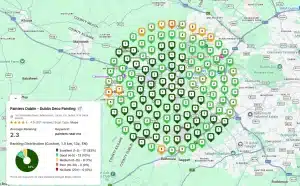
The “reviewgraphic” concept adds a visual layer to review statistics. By mapping reviews geographically, businesses uncover patterns hidden in text.
Inspired by this approach, ReviewGraphics helps identify:
- Regions with high customer satisfaction
- Locations generating the most complaints
- Areas with high lifetime value customers
- Local demand mismatches
When combined with Google Business Profile attributes, this insight becomes invaluable for local optimization and expansion planning.
Turning Review Statistics Into Actionable Growth
Businesses that win in 2025 don’t just collect reviews. They use them to:
- Optimize landing pages using customer language
- Train staff using real feedback
- Improve product development
- Strengthen brand messaging
- Increase conversion rates
By combining analytics with automation tools like Wiremo Campaigns, businesses ensure review insights lead to measurable improvements.
Frequently Asked Questions About Review Statistics
1. Why are review statistics so important for businesses in 2025?
Review statistics directly influence trust, search visibility, conversions, and local rankings. They are no longer passive feedback but active growth signals used by customers and search engines.
2. How many reviews do customers usually read before making a decision?
Most customers form an opinion after reading between 2 and 6 reviews, but high-value purchases may require 10 or more reviews before committing.
3. Do negative reviews harm conversions?
Not necessarily. A mix of positive and negative reviews often increases trust, especially when businesses respond professionally and transparently.
4. How do review statistics impact local SEO?
Google uses review quantity, freshness, ratings, and responses as ranking signals for local results and Google Business Profiles.
5. Are star ratings more important than written reviews?
Star ratings influence quick decisions, while written reviews provide deeper context. Both work together to build trust.
6. What is the “reviewgraphic” concept?
Reviewgraphics visualizes customer review data geographically, helping businesses understand regional satisfaction, demand, and performance patterns.
7. How often should businesses collect new reviews?
Consistently. Fresh reviews signal relevance to both customers and search engines and help maintain ranking momentum.
8. Can reviews influence customer spending?
Yes. Studies show customers spend up to 31% more with businesses that maintain strong review profiles.
9. Why do customers trust reviews more than ads?
Reviews come from real experiences, while ads are perceived as biased. Peer validation carries more credibility.
10. Should businesses respond to every review?
Yes. Responding shows accountability, builds trust, and increases customer loyalty.
11. How do mobile users interact with reviews differently?
Mobile users who read reviews are significantly more likely to convert, especially when reviews are easy to scan and well structured.
12. Can reviews help improve products and services?
Absolutely. Review trends reveal pain points, feature requests, and service gaps that businesses can act on quickly.
13. How many reviews does a business need to appear trustworthy?
There is no fixed number, but businesses with 50+ reviews typically see stronger trust and higher conversion rates.
14. Are reviews useful for B2B companies?
Yes. B2B buyers rely heavily on reviews to assess reliability, service quality, and long-term partnership potential.
15. How can businesses turn review statistics into growth?
By analyzing review data to optimize messaging, improve service, guide product development, and strengthen marketing strategies.