If you run a local company, you do not need more traffic. You need the right local customers to find you when they are ready to buy. That is what local SEO for small businesses is for. It helps you show up in Google Maps, the Local Pack, and nearby searches that lead to calls, directions, bookings, and walk-ins.
The problem is that most small businesses do random tasks. They post a few photos, tweak a page title, ask for reviews, and then hope rankings improve. That is not a strategy. A real strategy is a documented plan that starts with your current visibility, studies competitors, finds the fastest opportunities, and then turns those opportunities into a weekly action list.
What you will get from this guide
- A practical blueprint for building a local SEO strategy for small businesses
- A step-by-step audit process for your website and Google Business Profile
- A competitor research system that reveals what is actually working in your area
- Clear opportunities you can prioritize, even with limited time and budget
- A complete action plan you can run weekly, monthly, and quarterly
What Is a Local SEO for Small Business Strategy
A local SEO strategy is your blueprint for improving local visibility and turning that visibility into customers. It documents what you will do, why you will do it, and when you will do it. It also defines how you measure results so you do not waste months on tasks that do not move the needle.
Think of it like this. Your Google Business Profile is the storefront sign, your website is the sales staff, your reviews are the trust, and your citations are the paperwork that proves you exist. Local SEO only works when all of those parts support each other.
What a complete strategy includes
- Baseline audit of your rankings, website health, listings, reviews, and citations
- Competitor analysis to identify why others outrank you
- Opportunity map so you know what to fix first for the fastest gains
- Action plan broken into weekly and monthly tasks
- Measurement so you can prove progress and make smarter decisions
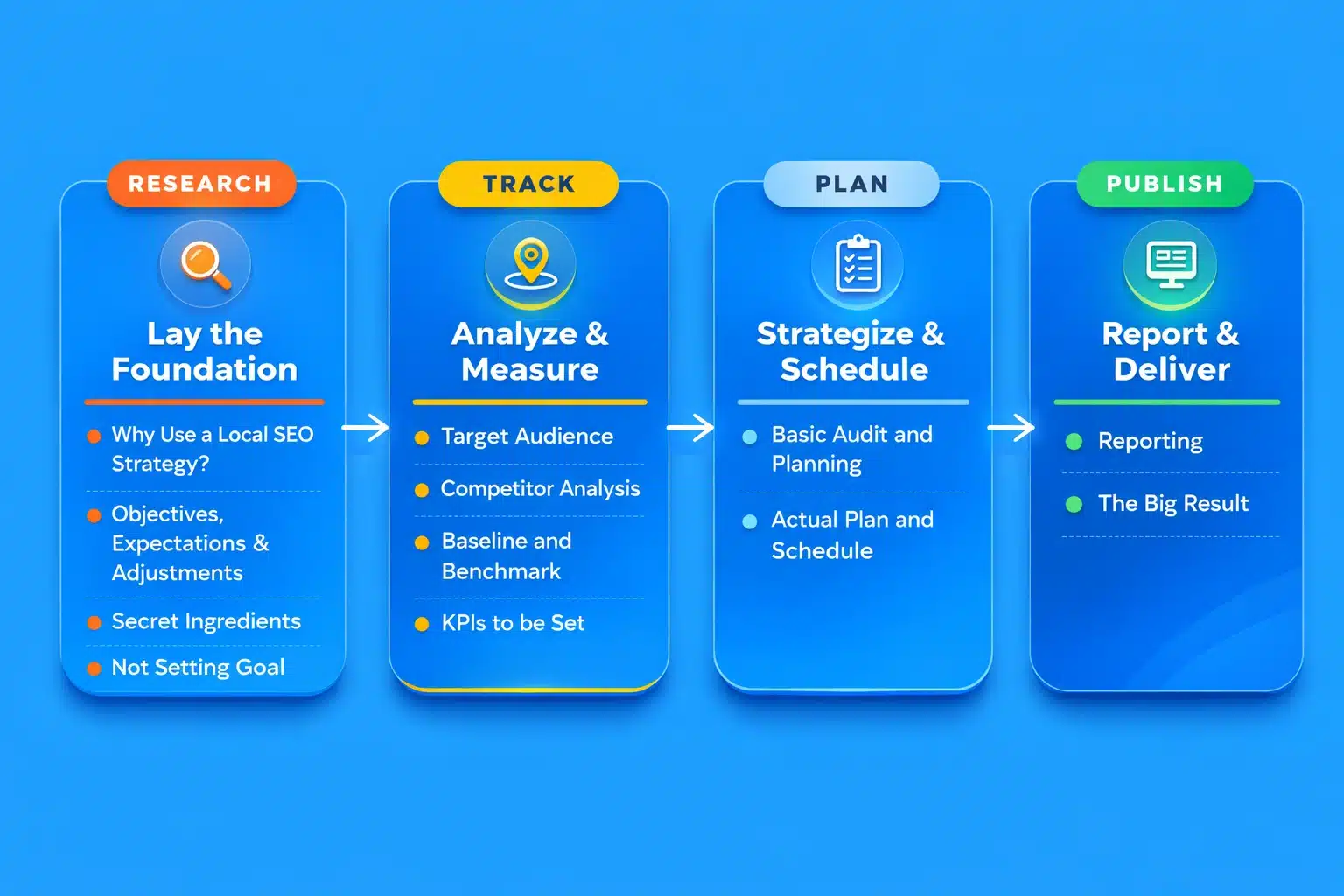
How to Create a Local SEO Strategy
A methodical approach wins. If you jump straight to content or backlinks without fixing foundational problems, results are slower, and rankings are unstable. Use the steps below to build a strategy that is realistic for a small business team.
The simplest way to think about local SEO is this: get the basics correct, match search intent, build trust, and then expand coverage across your service area.
Step 1: Document your present situation
Before you decide what to do, you must know where you are. This is your baseline. Without it, you cannot prove improvement and you will not know what changes caused your wins.
Your baseline checklist
- Which keywords bring you impressions and calls today
- Which pages get traffic and which do not
- How your Google Business Profile performs: calls, directions, website clicks
- How many reviews do you have, your rating, and your reply rate
- How consistent is your business information across the web
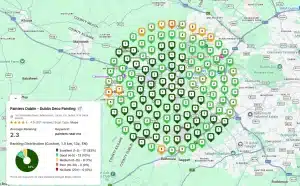
- Where you rank across your real service area, not only at your office location
1) Build a keyword ranking snapshot
Start with a list of your primary services and primary locations. Your goal is to map what you already rank for and what you should rank for. For small businesses, this usually includes:
- Service keywords, for example “plumber” or “barber”
- Service plus city, for example “plumber in Austin”
- Service plus neighborhood, for example “barber in Mission District”
- Service plus near me variants
Make a simple table in a doc or sheet. Track keyword, location, current position, and which page is ranking. This becomes your measurement framework.
2) Audit your website for local SEO blockers
Many local sites struggle due to basic issues, not advanced tactics. When you fix these early, everything else works better.
If your pages are slow, broken, thin, or confusing on mobile, you can add citations and reviews all day and still struggle. Fix the foundation first.
- Page titles and headings: do they clearly match local search intent
- Internal linking: can users and Google easily reach key service pages
- Content quality: do pages answer real questions, or are they generic
- Mobile experience: is it easy to call, book, or request a quote
- Technical health: broken links, redirect chains, duplicate pages, indexing issues
- Conversion path: clear phone number, forms, booking, and trust signals
3) Audit your Google Business Profile
For most industries, your Google Business Profile is the engine of local demand. A strategy should identify which fields are incomplete and which opportunities are unused.
Google Business Profile audit items
- Primary category and secondary categories are accurate
- The services list is complete and matches your website offerings
- Service areas or address settings are configured correctly
- Business hours, holiday hours, and special hours are up to date
- Description is clear, customer-focused, and not spammy
- Photos are recent and represent the business, not stock images
- Questions and answers are monitored and answered quickly
- Reviews are recent, and replies are consistent
4) Review and reputation snapshot
Reviews affect conversion, and in many cases, they correlate with stronger local performance because they reflect real demand. Track:
- Total review count on Google
- Average rating
- Review velocity, how many new reviews per month
- Reply rate, and whether replies include the service context naturally
- Top complaint themes you can fix operationally
5) Citation and listings snapshot
Citations are mentions of your business name, address, and phone number across directories and platforms. The strategy should identify incorrect listings, duplicates, and missing high-value profiles.
The most important rule is consistency. Your website, Google Business Profile, and major directories should show the same business name, address format, and phone number.
Step 2: Competitor research that actually helps
Your competitors are proof of what works in your market. If three businesses consistently outrank you, they are sending stronger relevance and trust signals. Your goal is not to copy them. Your goal is to identify which signals they are winning on and build a plan to beat them.
Competitor research checklist
- Which categories do they use on Google Business Profile
- How many reviews do they have, and how often do they get new ones
- What their top photos show, and how recent they are
- Which services do they highlight on their listings and websites
- What content do they publish that earns visibility, for example, guides and FAQs
- Where they have local links, sponsorships, community pages, and local news mentions
- Whether they use spam, for example, keyword stuffing in the business name
How to pick the right competitors
Do not compare yourself to national brands unless they compete directly in your city. Choose:
- 2 to 3 businesses that beat you in the Local Pack for your main keyword
- 2 businesses that rank well organically for your main service pages
- 1 competitor that is newer but growing fast, they often reveal a new tactic
Step 3: Identify opportunities and prioritize them
After the audit and competitor research, you will have a long list of tasks. The strategy becomes powerful when you prioritize based on impact and effort.
A good rule for small businesses is to fix high-impact foundation issues first, then build trust, then expand content and links.
High impact, low effort opportunities
- Fix NAP inconsistencies between the website and the Google Business Profile
- Add missing services to your Google Business Profile services list
- Improve your primary service page to match what customers ask
- Add strong calls to action and trust elements to the top pages
- Create a review reply process and respond consistently
- Add fresh, real photos each month
Medium effort opportunities that compound over time
- Build a locally relevant FAQ section that targets real questions
- Create location pages only where you can add unique, helpful details
- Earn local links through partnerships, events, and community sponsorships
- Publish helpful content that supports your services, not generic blog posts
Step 4: Turn the strategy into an action plan
Strategy is useless if it does not translate into tasks you can execute. Below is a simple system that works for most local industries.
Weekly tasks
- Request new reviews from recent customers, using a consistent process
- Reply to every new review within 48 hours
- Post new photos, real work, team, location, before and after
- Check and respond to Q and A
- Track your key rankings and visibility trends
Monthly tasks
- Publish 1 high-quality piece of local content or upgrade a key service page
- Fix 5 to 20 citation issues, duplicates, or missing listings
- Earn 1 to 3 local links from real partnerships, not random sites
- Review Google Business Profile insights and adjust priorities
- Compare yourself to competitors on reviews, photos, and categories
Quarterly tasks
- Run a full website and GBP audit again to catch regressions
- Refresh top-performing pages with new images, FAQs, and proof
- Plan seasonal campaigns and publish locally relevant guides
- Identify spam listings and report them if they violate policies
What Are the Best Tactics for Local SEO for Small Business
Most small businesses win by doing the basics better than everyone else, consistently. These are the tactics that drive the biggest results when combined into a system.
1) Google Business Profile optimization
Treat your Google Business Profile like your main local landing page. Keep it complete, accurate, and active. Focus on categories, services, photos, reviews, Q and A, and consistent updates.
2) Website pages that match real intent
A strong service page answers what customers want to know. Price ranges, timelines, service areas, what is included, who performs the work, and proof. Add FAQs based on real calls and messages.
3) Reviews and replies that build trust
Reviews are not only about ratings. They are sales proof. A small business can beat larger competitors by getting more recent reviews and replying with care and detail.
4) Citations and consistency
Build a clean citation footprint. Fix incorrect listings and remove duplicates. Then add the most important directories for your country and industry. Consistency matters more than volume.
5) Local links that are real
Sponsorships, community events, local charities, neighborhood associations, local suppliers, and partnerships can earn the strongest local links because they are real relationships.
6) Content that supports your services
Small businesses should avoid generic blog posts. Publish content that helps customers decide. Examples include local buying guides, service comparisons, cost factors, common problems, and checklists.
Example Local SEO Strategy for a Small Business
To make this practical, here is a sample strategy for a small business: a neighborhood HVAC company serving a mid size city with several suburbs.
Goal: increase calls for “AC repair”, “furnace repair”, and “HVAC installation” across multiple neighborhoods, not only near the office.
Google Business Profile plan
- Confirm the primary category and add the right secondary categories
- Add every core service to the services list with clear names
- Upload 10 new photos per month, including trucks, team, installs, before and after
- Reply to every review and add a review request step after each job
- Seed a Q and A section with common FAQs and answers
- Update hours and add holiday hours for the trust
Website optimization plan
- Upgrade core service pages with clearer proof, FAQs, and conversion elements
- Create a “Service Areas” hub page linking to key suburbs
- Add internal links from blog guides to service pages
- Improve mobile speed and simplify the booking flow
- Add local trust blocks: licenses, insurance, warranties, financing, testimonials
Citations plan
- Fix mismatched address formats across top directories
- Remove duplicate listings and closed flags
- Add missing industry directories and local chamber listings
- Maintain a tracking sheet with URLs and login access
Local link-building plan
- Partner with local property managers and sponsor a community page
- Join local business associations and earn directory links
- Publish a seasonal guide that local blogs can reference
Content plan
- “AC repair cost in [city]” with real factors and ranges
- “Signs you need a new furnace” with a decision checklist
- “Best thermostat settings for winter” plus energy tips
- “HVAC maintenance checklist” with printable steps
This is what a strategy looks like: not random tasks, but a connected system built around rankings, trust, and conversions.
Common Mistakes Small Businesses Make With Local SEO
They track only one location point
Many businesses check rankings from their office computer and think they are doing great. Local rankings change by location. You need to know how you perform across your service area, especially where customers actually live.
They copy competitor spam
If competitors stuff keywords into the business name, it can be tempting to do the same. This often backfires. A better strategy is to build stronger trust and report clear violations through proper channels.
They publish generic content
Generic posts do not win local markets. Content should match services, local intent, pricing questions, and decision-making. One strong guide can outperform ten weak blog posts.
They ignore reviews until there is a problem
Review management is ongoing. A steady stream of real reviews and consistent replies builds momentum and helps conversions even before rankings improve.
How to Measure Progress
A strategy must define how you measure outcomes. Rankings matter, but small businesses should focus on business results too.
- Visibility: how often you appear in Google Maps and the Local Pack across your area
- Engagement: calls, directions, messages, bookings
- Conversion: leads that turn into sales
- Reputation: review growth, rating stability, reply speed
- Authority: quality local links and mentions
If you only track rankings, you may miss the real wins. Many local SEO improvements show up first as more calls and better conversion rates, then rankings catch up.
Frequently Asked Questions
1. How long does local SEO take for a small business
It depends on competition and your starting point. Many businesses see early movement in 4 to 8 weeks after fixing major issues, but the best results come from consistent execution over several months.
2. What should I do first if I have limited time
Start with the basics: fix NAP consistency, complete your Google Business Profile, improve your main service page, and create a review process. Those four steps usually produce the fastest gains.
3. Is local SEO worth it for very small businesses
Yes. Local SEO is one of the highest ROI channels because it targets people already searching for what you sell. Even a small improvement in visibility can create steady monthly leads.
4. Do I need a blog for local SEO
Not always, but you do need content that answers questions and supports your services. This can be service page FAQs, guides, pricing pages, and comparison pages. A blog is useful when it publishes decision-making content, not generic updates.